
All rights reserved to the presidency Copyright © 2020


My brother, Your Excellency President Yoweri Museveni,
President of the Republic of Uganda,
It gives me pleasure to welcome you and your accompanying delegation today to your second home, Egypt. We highly value this visit, which comes within the historical relations that bind our countries and peoples, connected by the eternal bond of the Nile River and united by decades of solidarity and cooperation in various fora and fields.
Ladies and gentlemen,
Egyptian-Ugandan relations have witnessed remarkable development recently, reflecting the close ties and interests that bind our countries. During talks with His Excellency President Museveni today , I affirmed Egypt's keenness to elevate relations with Uganda to broader prospects. We look forward to His Excellency's visit to usher in a new phase of partnership between our countries.
We witnessed the signing of a number of MoUs in the fields of technical cooperation in water resource management, agricultural and food cooperation, investment, mutual exemption from entry visas for holders of official passports, and diplomatic cooperation to support the establishment of a Ugandan diplomatic institute.
We also discussed ways to activate economic cooperation and increase trade exchange between the two countries. We agreed to expedite the formation of a joint business council and encourage visits between the business communities, which will contribute to achieving mutual interests. In this context, a joint business forum will be held on the sidelines of the visit to identify available investment opportunities in both countries and begin taking effective executive steps in this area.
We also touched on opportunities for cooperation in training and capacity building and affirmed our keenness to pursue cooperation in combating veterinary diseases. Moreover, we stressed our growing interest in cooperation in the energy sector.
In the security field, we agreed to continue the existing cooperation, particularly in light of the important developments, following the recent visit of Uganda's Chief of Defence Force to Egypt and agreement to hold the Military Cooperation Committee annually.
Ladies and gentlemen,
President Museveni and I exchanged views on the Nile River, the lifeline for our two countries. We agreed that the optimal handling of this issue among Nile Basin countries must be based on the necessity of enhancing efforts to achieve mutual benefit, joint action to preserve and develop this vital resource, and cooperation within the format of "considering the interests of all" without causing harm, in accordance with the rules of international law.
As President Museveni wisely stated: "Without preserving the environment of the Nile Basin, we will have nothing to share."
From this standpoint, I reaffirmed to President Museveni our full support for development efforts in Uganda and the rest of southern Nile Basin countries, and our readiness to contribute to the funding of the Angololo Dam project between Uganda and Kenya through the mechanism that Egypt launched for investing in infrastructure projects in the Nile Basin with an initial funding of $100 million.
I am pleased to announce that we signed a new MoU today in the field of integrated water resource management to build upon more than 20 years of cooperation between our two countries. This is aimed at preserving the Nile River's environment and developing its resources, with a total value of $6 million over five years. This confirms our steadfast commitment to supporting development in Uganda and the rest of the Nile Basin countries.
In the same context, I reiterated our confidence in the constructive role Uganda plays in leading the consultative process in the Nile Basin initiative to restore inclusivity and consensus among the basin countries to achieve mutual benefit.
I also stressed Egypt's firm rejection of unilateral actions in the Eastern Nile Basin, which we have sought to be a source of cooperation, not conflict. Wrongful is that who deludes himself into thinking that Egypt will turn a blind eye to an existential threat to its water security. We will continue to monitor and take all measures guaranteed by international law to preserve the existential resources of our people.
Allow me to pause here because this topic was a subject of a long discussion between me and His Excellency President Museveni. First, due to his wisdom, and second, due to his long experience. We agreed that the issue of water is crucial and that development is also important. Our stance has been clear from the beginning. We are not against the development of our partners and brothers in the Nile Basin countries. We have no problem with that, and this development should not affect the volume or share of water that reaches Egypt.
During my discussion with His Excellency, the President of Uganda, I encountered a perspective that I believe should be conveyed to you.
His Excellency inquired whether we are all united in our position. I confirmed that we are indeed united, and that there is no disagreement on this matter.
President Museveni noted that, based on scientific principles, the volume of water that falls over the basin—whether the Blue Nile or the White Nile—amounts to approximately 1,600 billion cubic meters of water annually. The water is divided, with a portion going to forests and swamps, a portion used for agriculture, a portion lost to evaporation, a portion going to groundwater, and a small portion reaching the White and Blue Niles. This is approximately 85 billion cubic meters of water that we are talking about, representing about 4% of the 1,600 billion cubic meters.
When we demand that this volume of water reaches Egypt and Sudan for us to live on, since we have no other source, does that mean rejecting development in the basin countries or refusing to benefit from the water available to them, whether for agriculture or electricity generation?
Of course not. I emphasize this here, in the presence of the President and before you. I say to the Egyptians that our position from the beginning is that we are not against development. We did not talk about the just distribution of water, as that would mean talking about the 1,600 billion cubic meters of water. Instead, we are talking about the remainder, which does not exceed 4% or 5%. This is a very important matter. We do not say "us and them," but rather all of us. I do not say only Egypt and Sudan, and them. Rather, I say that we are all together. We all live, we all develop, and we all cooperate for the prosperity and stability of our countries. For this reason, I emphasize once again regarding the issue of water for Egypt that there is no other way for us.
His Excellency, the President, told me that in Uganda, Egypt means "the garden." And this garden has no other source of water except the Nile, as there is no rain. Therefore, no one can imagine that Egypt will abandon it. Abandoning any part of it means abandoning our lives. This will not happen. I wanted to mention this point. We rely heavily on the seven-nation committee led by Uganda to reach a consensus for the benefit and cooperation of all basin countries. There are many countries that have similar issues and managed to reach understandings and agreements for everyone. We want to reach this point.
In connection with this point, Your Excellency, the President, I would like to clarify that those who have rain never feel the same way as those who don't. Egypt does not have rain. The Egyptian people have a very strong sense of caution and are concerned about the issue of water. I tell the Egyptian people that I understand that and that I am responsible, along with my brothers and wise people like President Museveni, for finding a solution that will never affect the lives of Egyptians.
Egypt faces a lot of pressure on this issue, and water may be part of this pressure campaign to achieve other goals. We are aware of that. I reaffirm once again that we are always against interfering in the affairs of others, against conspiring against others, and against demolition and destruction. We stand for construction, cooperation, and development. Countries in Africa have had enough of long years of fighting and conflict.
I reassure the Egyptians once again, by Allah’s will, on this matter, we will never allow the water, which 105 million people and approximately 10 million guests (whom we do not call refugees) live on, to be compromised.
I emphasize and repeat that the awareness and resilience of the Egyptian people are the main pillars that I rely on in confronting any potential challenge or threat.
In the end, I thank you, and I thank His Excellency the President once again, and I welcome him to his country, Egypt.
Thank you.


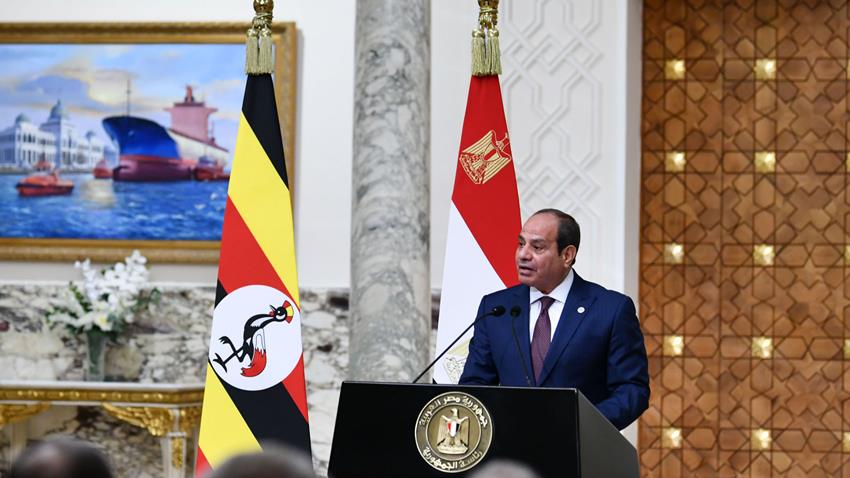

My brother, Your Excellency President Yoweri Museveni,
President of the Republic of Uganda,
It gives me pleasure to welcome you and your accompanying delegation today to your second home, Egypt. We highly value this visit, which comes within the historical relations that bind our countries and peoples, connected by the eternal bond of the Nile River and united by decades of solidarity and cooperation in various fora and fields.
Ladies and gentlemen,
Egyptian-Ugandan relations have witnessed remarkable development recently, reflecting the close ties and interests that bind our countries. During talks with His Excellency President Museveni today , I affirmed Egypt's keenness to elevate relations with Uganda to broader prospects. We look forward to His Excellency's visit to usher in a new phase of partnership between our countries.
We witnessed the signing of a number of MoUs in the fields of technical cooperation in water resource management, agricultural and food cooperation, investment, mutual exemption from entry visas for holders of official passports, and diplomatic cooperation to support the establishment of a Ugandan diplomatic institute.
We also discussed ways to activate economic cooperation and increase trade exchange between the two countries. We agreed to expedite the formation of a joint business council and encourage visits between the business communities, which will contribute to achieving mutual interests. In this context, a joint business forum will be held on the sidelines of the visit to identify available investment opportunities in both countries and begin taking effective executive steps in this area.
We also touched on opportunities for cooperation in training and capacity building and affirmed our keenness to pursue cooperation in combating veterinary diseases. Moreover, we stressed our growing interest in cooperation in the energy sector.
In the security field, we agreed to continue the existing cooperation, particularly in light of the important developments, following the recent visit of Uganda's Chief of Defence Force to Egypt and agreement to hold the Military Cooperation Committee annually.
Ladies and gentlemen,
President Museveni and I exchanged views on the Nile River, the lifeline for our two countries. We agreed that the optimal handling of this issue among Nile Basin countries must be based on the necessity of enhancing efforts to achieve mutual benefit, joint action to preserve and develop this vital resource, and cooperation within the format of "considering the interests of all" without causing harm, in accordance with the rules of international law.
As President Museveni wisely stated: "Without preserving the environment of the Nile Basin, we will have nothing to share."
From this standpoint, I reaffirmed to President Museveni our full support for development efforts in Uganda and the rest of southern Nile Basin countries, and our readiness to contribute to the funding of the Angololo Dam project between Uganda and Kenya through the mechanism that Egypt launched for investing in infrastructure projects in the Nile Basin with an initial funding of $100 million.
I am pleased to announce that we signed a new MoU today in the field of integrated water resource management to build upon more than 20 years of cooperation between our two countries. This is aimed at preserving the Nile River's environment and developing its resources, with a total value of $6 million over five years. This confirms our steadfast commitment to supporting development in Uganda and the rest of the Nile Basin countries.
In the same context, I reiterated our confidence in the constructive role Uganda plays in leading the consultative process in the Nile Basin initiative to restore inclusivity and consensus among the basin countries to achieve mutual benefit.
I also stressed Egypt's firm rejection of unilateral actions in the Eastern Nile Basin, which we have sought to be a source of cooperation, not conflict. Wrongful is that who deludes himself into thinking that Egypt will turn a blind eye to an existential threat to its water security. We will continue to monitor and take all measures guaranteed by international law to preserve the existential resources of our people.
Allow me to pause here because this topic was a subject of a long discussion between me and His Excellency President Museveni. First, due to his wisdom, and second, due to his long experience. We agreed that the issue of water is crucial and that development is also important. Our stance has been clear from the beginning. We are not against the development of our partners and brothers in the Nile Basin countries. We have no problem with that, and this development should not affect the volume or share of water that reaches Egypt.
During my discussion with His Excellency, the President of Uganda, I encountered a perspective that I believe should be conveyed to you.
His Excellency inquired whether we are all united in our position. I confirmed that we are indeed united, and that there is no disagreement on this matter.
President Museveni noted that, based on scientific principles, the volume of water that falls over the basin—whether the Blue Nile or the White Nile—amounts to approximately 1,600 billion cubic meters of water annually. The water is divided, with a portion going to forests and swamps, a portion used for agriculture, a portion lost to evaporation, a portion going to groundwater, and a small portion reaching the White and Blue Niles. This is approximately 85 billion cubic meters of water that we are talking about, representing about 4% of the 1,600 billion cubic meters.
When we demand that this volume of water reaches Egypt and Sudan for us to live on, since we have no other source, does that mean rejecting development in the basin countries or refusing to benefit from the water available to them, whether for agriculture or electricity generation?
Of course not. I emphasize this here, in the presence of the President and before you. I say to the Egyptians that our position from the beginning is that we are not against development. We did not talk about the just distribution of water, as that would mean talking about the 1,600 billion cubic meters of water. Instead, we are talking about the remainder, which does not exceed 4% or 5%. This is a very important matter. We do not say "us and them," but rather all of us. I do not say only Egypt and Sudan, and them. Rather, I say that we are all together. We all live, we all develop, and we all cooperate for the prosperity and stability of our countries. For this reason, I emphasize once again regarding the issue of water for Egypt that there is no other way for us.
His Excellency, the President, told me that in Uganda, Egypt means "the garden." And this garden has no other source of water except the Nile, as there is no rain. Therefore, no one can imagine that Egypt will abandon it. Abandoning any part of it means abandoning our lives. This will not happen. I wanted to mention this point. We rely heavily on the seven-nation committee led by Uganda to reach a consensus for the benefit and cooperation of all basin countries. There are many countries that have similar issues and managed to reach understandings and agreements for everyone. We want to reach this point.
In connection with this point, Your Excellency, the President, I would like to clarify that those who have rain never feel the same way as those who don't. Egypt does not have rain. The Egyptian people have a very strong sense of caution and are concerned about the issue of water. I tell the Egyptian people that I understand that and that I am responsible, along with my brothers and wise people like President Museveni, for finding a solution that will never affect the lives of Egyptians.
Egypt faces a lot of pressure on this issue, and water may be part of this pressure campaign to achieve other goals. We are aware of that. I reaffirm once again that we are always against interfering in the affairs of others, against conspiring against others, and against demolition and destruction. We stand for construction, cooperation, and development. Countries in Africa have had enough of long years of fighting and conflict.
I reassure the Egyptians once again, by Allah’s will, on this matter, we will never allow the water, which 105 million people and approximately 10 million guests (whom we do not call refugees) live on, to be compromised.
I emphasize and repeat that the awareness and resilience of the Egyptian people are the main pillars that I rely on in confronting any potential challenge or threat.
In the end, I thank you, and I thank His Excellency the President once again, and I welcome him to his country, Egypt.
Thank you.

All rights reserved to the presidency Copyright © 2020
All rights reserved to the presidency Copyright © 2020