
All rights reserved to the presidency Copyright © 2020


Tuesday, 01 September 2026 / 10:08 AM
Cairo and Beijing: A Renewed Strategic Partnership
Together for a More Prosperous Future for the Egyptian and Chinese Peoples and for Humanity
By: Abdel Fattah El-Sisi, President of the Arab Republic of Egypt
This year, we celebrate the 70th anniversary of the establishment of diplomatic relations between the Arab Republic of Egypt and the People's Republic of China. Egypt was the first Arab and African country to establish diplomatic relations with China in 1956, extending civilizational and historical ties between two nations deeply rooted in the depths of history. As we celebrate this special anniversary between our two friendly countries, we welcome the visit of Chinese President Xi Jinping to Egypt as an esteemed and cherished guest.
Over various historical eras, Egypt and China have remained connected across bridges of friendship. These bridges link the eternal Nile River, the cradle of Egyptian civilization and the lifeline of the Egyptian people, with the great Yangtze River, which recognized as the birthplace of ancient Chinese civilization and the source of Chinese wisdom and philosophy. The two civilizations, through the science and knowledge they offered, contributed to the renaissance of nations and the progress of humanity along a path connecting the Pyramids to the Great Wall of China. This includes the profound contributions of Egyptian civilization to medicine, engineering, and astronomy, alongside the advanced innovations of Chinese civilization that were far ahead of their time, upon which modern scientists relied in recent centuries, paving the way for the industrial and technological revolutions and their unprecedented achievements. Had it not been for the cumulative knowledge provided by the two civilizations, the world would not have reached this advanced stage of huge development across all domains. This underscores the right of Egypt and China to share modern technology in a fair manner that achieves comprehensive development for the peoples of both countries and for all nations, contributing to the advancement of human civilization.
The two countries were connected by a historical trade route that facilitated the movement of people and goods. It stretched from the Chinese Silk Road to the Red Sea and Egypt's Suez Canal, the lifeline of global trade. Along this path, trade missions and caravans traveled from Chinese and Asian shores to Egyptian ports on the Red and Mediterranean Seas, which continue their historical role to this day as an indispensable link between East and West.
Egyptian ports served as the largest commercial hub for trading goods between Asia, Europe, and Africa. Through this vital route, the cultures and ideas of both peoples were exchanged, thereby strengthening the historical bonds between the Egyptian and Chinese peoples and shaping a nucleus of common ground upon which centuries of enduring popular, commercial, and cultural relations were built. This culminated in the establishment of diplomatic relations between our two countries seven decades ago at a critical historical moment that marked a turning point in the development and prosperity of bilateral relations.
Egypt was the first Arab and African country to establish diplomatic relations with the People's Republic of China, at a defining moment in which Egypt expressed its support for the freedom of peoples to choose their own political and economic systems freely. Thus, Egypt paved the way for Arab and African relations with China, which grew and flourished over the years, leading to the launch of the China-Arab States Cooperation Forum and the Forum on China-Africa Cooperation. Egypt has consistently upheld the One-China principle, opposed interference in China's internal affairs, and supported China's restoration of its permanent seat on the UN Security Council. For its part, China has supported Arab rights and the Palestinian people's right to establish an independent state, unforgettable historical stances that remain etched in the memory of both nations as shining beacons both peoples recall as they celebrate together this cherished anniversary, serving as a foundation for solidarity between the two peoples and a launching pad for greater mutual support and alignment.
Relations between Egypt and China have developed significantly over the past seven decades, culminating in the declaration of a Comprehensive Strategic Partnership between the two countries in 2014 during my first official visit to the People's Republic of China. At that critical juncture, Egypt was keen on fostering broad, long-standing relations with countries across the globe, diversifying its foreign policy, and extending its hands to all friends to build broader and deeper partnerships with all countries in the world which were keen on forging closer relations with Egypt grounded in mutual respect, solidarity, and mutual benefit. Egypt sought to make concerted efforts to advance joint development in infrastructure, investment, trade, manufacturing, and technology transfer. China was among the first countries to demonstrate its keenness on consolidating relations with Egypt on the basis of these firm principles, which formed the solid foundation for longstanding and lasting relations that have delivered mutual benefits to both peoples and safeguarded the interests of both countries.
Building upon the above, the Comprehensive Strategic Partnership established by the two countries has driven a major leap forward in bilateral relations. China has become a primary trade and economic partner for Egypt, accompanied by growing direct Chinese investment, including within the Suez Canal Economic Zone. This zone has offered vast opportunities for Chinese investors to generate returns and capitalize on the significant advantages provided to foreign investors, featuring industrial zones that encompass leading international factories from various countries seeking to leverage these opportunities, alongside Egypt's strategic position at the heart of the world as an essential link between East and West.
Furthermore, Chinese companies have contributed to several mega national projects, such as the construction of the Central Business District in the New Capital, the launch of the 10th of Ramadan Light Rail Transit (LRT), the construction of renewable energy plants, and port developments, among other projects within the state's national plans to upgrade infrastructure in cooperation with various partners, including China. These efforts have contributed to promoting Egypt to a high global ranking in infrastructure, serving as a key element in establishing an advanced foundation for an integrated industrial base and transforming Egypt into a global logistics hub for industry, trade, and services.
This significant progress achieved by Egypt in strengthening its infrastructure has turned it into an important destination for establishing major industrial investments from around the world. China was among the countries keen on establishing industries in Egypt and benefiting from the major advantages offered in this field.
Egypt and China agree on the need to capitalize on the collaboration between Egypt's national strategy for localizing industry and China's high-quality development strategy, thereby attracting more Chinese industries to Egypt. This includes electric vehicles, energy storage batteries, renewable energy, electronic devices, components for seawater desalination plants, and shipbuilding, among others. This is, in addition to enhancing technology transfer in telecommunications, Artificial Intelligence, and space sciences as top priorities for economic and technological development, as well as key pathways for Egyptian-Chinese cooperation in the coming period.
The Chinese development experience and its ability to achieve economic progress and eradicate extreme poverty have served as a source of inspiration for developing countries seeking to fulfill their aspirations for modernization and growth. Egypt views this experience positively, while believing that nations of the developing world possess immense opportunities to move forward and achieve an economic renaissance that aligns with development models suited to their unique historical and cultural circumstances. In this context, it is important to underline the need to create a conducive global environment that allows these countries to reach this desired goal.
From this standpoint, Egypt has assumed its regional and international role over past decades, upholding the principles and purposes of the UN Charter, international law, and the rules-based international order. Egypt has been keen on supporting international organizations to fulfil their original mandate to protect international peace and security, contributing significantly to peacekeeping and peacebuilding operations. It has also joined forces with all members of the international community to bolster the role of global economic organizations in achieving comprehensive global development and advancing the UN Sustainable Development Goals.
Egypt has firmly maintained its stance in support of the empowerment of the voice of the Global South, increasing its representation in international institutions and ensuring respect for these nations' rights to express their will and address their concerns. Keen to strengthen South-South dialogue and open up broad, diverse partnerships worldwide, Egypt joined several emerging institutions, becoming a member of BRICS in 2024, its New Development Bank, and the Asian Infrastructure Investment Bank, while also joining the Shanghai Cooperation Organization as a dialogue partner. I seize this opportunity to congratulate China on assuming the BRICS chairmanship next year, confirming that Egypt looks forward to coordinating and consulting with China within this framework.
Egypt has maintained a policy of strategic balance to guide its foreign policy at a time of rising polarization and competition, reaffirming its independent foreign policy and calling for coordinated international efforts to overcome global challenges that threaten the entire world. Egypt and China have become partners who, together, contribute to bolstering the role of the Global South in the international order, achieving greater fairness and equity for developing nations.
From this same perspective, Egypt has exerted relentless diplomatic efforts to de-escalate tensions in the Middle East and prevent the conflict from expanding. The region is currently passing through a dangerous phase of conflicts that threaten regional security and stability, as well as international peace and security. In this context, Egypt and China agree on the necessity of resolving conflicts through peaceful means, addressing the security concerns of all parties, and respecting state sovereignty as the foundation for peaceful conflict settlement, recognizing that expanding the conflict and fueling armed confrontation serves the interests of no regional or international party.
Similarly, the Nile River has been the foundation of Egyptian civilization and a vital source of its prosperity throughout history. For thousands of years, Egypt and other Nile Basin countries have drawn life from the Nile, as its waters have represented a shared resource and the core of life, development, and human well-being. Throughout its history, Egypt has remained committed to supporting the development of Nile Basin states, particularly in water resource development and dam construction, including in Sudan and Uganda, and most recently, through its contribution to the massive Julius Nyerere Hydropower Project in Tanzania.
Egypt will remain steadfast in advocating for transboundary cooperation grounded in the principles and rules of international law, rather than unilateral approaches that inflict harm on downstream nations. Egypt firmly believes that the sustainable management of shared water resources can only be achieved through prior notification, consultation, and consensus among riparian states.
In this regard, Egypt deeply appreciates China's stance, which reaffirmed its recognition of the Nile River's vital importance to Egypt as its primary lifeline, while reiterating the necessity of refraining from unilateral measures and fostering cooperation in good faith to achieve mutual benefit and win-win outcomes.
Just as we have written chapters of cooperation and friendship between our two friendly nations over past years, we look forward to forging a new chapter together in Egyptian-Chinese friendship, a bond spanning thousands of years, aspiring toward new decades of progress and prosperity for our friendly peoples, and wishing the world more stability, security, and development.


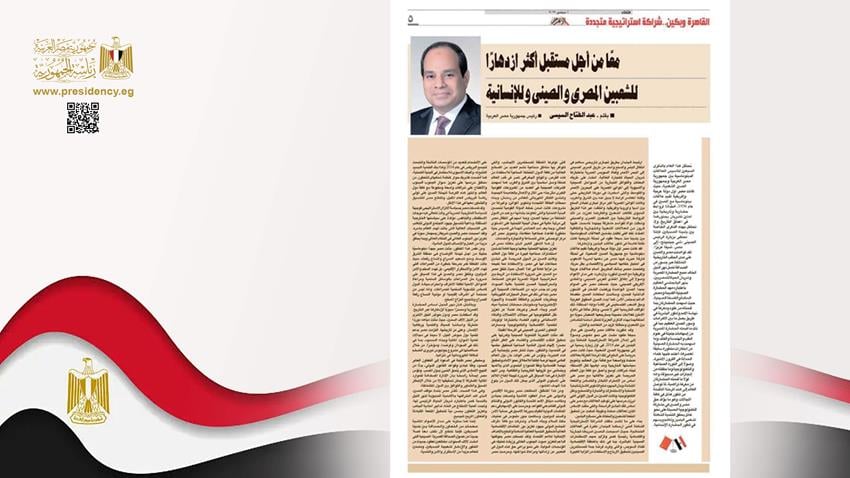
Tuesday, 01 September 2026 / 10:08 AM
Cairo and Beijing: A Renewed Strategic Partnership
Together for a More Prosperous Future for the Egyptian and Chinese Peoples and for Humanity
By: Abdel Fattah El-Sisi, President of the Arab Republic of Egypt
This year, we celebrate the 70th anniversary of the establishment of diplomatic relations between the Arab Republic of Egypt and the People's Republic of China. Egypt was the first Arab and African country to establish diplomatic relations with China in 1956, extending civilizational and historical ties between two nations deeply rooted in the depths of history. As we celebrate this special anniversary between our two friendly countries, we welcome the visit of Chinese President Xi Jinping to Egypt as an esteemed and cherished guest.
Over various historical eras, Egypt and China have remained connected across bridges of friendship. These bridges link the eternal Nile River, the cradle of Egyptian civilization and the lifeline of the Egyptian people, with the great Yangtze River, which recognized as the birthplace of ancient Chinese civilization and the source of Chinese wisdom and philosophy. The two civilizations, through the science and knowledge they offered, contributed to the renaissance of nations and the progress of humanity along a path connecting the Pyramids to the Great Wall of China. This includes the profound contributions of Egyptian civilization to medicine, engineering, and astronomy, alongside the advanced innovations of Chinese civilization that were far ahead of their time, upon which modern scientists relied in recent centuries, paving the way for the industrial and technological revolutions and their unprecedented achievements. Had it not been for the cumulative knowledge provided by the two civilizations, the world would not have reached this advanced stage of huge development across all domains. This underscores the right of Egypt and China to share modern technology in a fair manner that achieves comprehensive development for the peoples of both countries and for all nations, contributing to the advancement of human civilization.
The two countries were connected by a historical trade route that facilitated the movement of people and goods. It stretched from the Chinese Silk Road to the Red Sea and Egypt's Suez Canal, the lifeline of global trade. Along this path, trade missions and caravans traveled from Chinese and Asian shores to Egyptian ports on the Red and Mediterranean Seas, which continue their historical role to this day as an indispensable link between East and West.
Egyptian ports served as the largest commercial hub for trading goods between Asia, Europe, and Africa. Through this vital route, the cultures and ideas of both peoples were exchanged, thereby strengthening the historical bonds between the Egyptian and Chinese peoples and shaping a nucleus of common ground upon which centuries of enduring popular, commercial, and cultural relations were built. This culminated in the establishment of diplomatic relations between our two countries seven decades ago at a critical historical moment that marked a turning point in the development and prosperity of bilateral relations.
Egypt was the first Arab and African country to establish diplomatic relations with the People's Republic of China, at a defining moment in which Egypt expressed its support for the freedom of peoples to choose their own political and economic systems freely. Thus, Egypt paved the way for Arab and African relations with China, which grew and flourished over the years, leading to the launch of the China-Arab States Cooperation Forum and the Forum on China-Africa Cooperation. Egypt has consistently upheld the One-China principle, opposed interference in China's internal affairs, and supported China's restoration of its permanent seat on the UN Security Council. For its part, China has supported Arab rights and the Palestinian people's right to establish an independent state, unforgettable historical stances that remain etched in the memory of both nations as shining beacons both peoples recall as they celebrate together this cherished anniversary, serving as a foundation for solidarity between the two peoples and a launching pad for greater mutual support and alignment.
Relations between Egypt and China have developed significantly over the past seven decades, culminating in the declaration of a Comprehensive Strategic Partnership between the two countries in 2014 during my first official visit to the People's Republic of China. At that critical juncture, Egypt was keen on fostering broad, long-standing relations with countries across the globe, diversifying its foreign policy, and extending its hands to all friends to build broader and deeper partnerships with all countries in the world which were keen on forging closer relations with Egypt grounded in mutual respect, solidarity, and mutual benefit. Egypt sought to make concerted efforts to advance joint development in infrastructure, investment, trade, manufacturing, and technology transfer. China was among the first countries to demonstrate its keenness on consolidating relations with Egypt on the basis of these firm principles, which formed the solid foundation for longstanding and lasting relations that have delivered mutual benefits to both peoples and safeguarded the interests of both countries.
Building upon the above, the Comprehensive Strategic Partnership established by the two countries has driven a major leap forward in bilateral relations. China has become a primary trade and economic partner for Egypt, accompanied by growing direct Chinese investment, including within the Suez Canal Economic Zone. This zone has offered vast opportunities for Chinese investors to generate returns and capitalize on the significant advantages provided to foreign investors, featuring industrial zones that encompass leading international factories from various countries seeking to leverage these opportunities, alongside Egypt's strategic position at the heart of the world as an essential link between East and West.
Furthermore, Chinese companies have contributed to several mega national projects, such as the construction of the Central Business District in the New Capital, the launch of the 10th of Ramadan Light Rail Transit (LRT), the construction of renewable energy plants, and port developments, among other projects within the state's national plans to upgrade infrastructure in cooperation with various partners, including China. These efforts have contributed to promoting Egypt to a high global ranking in infrastructure, serving as a key element in establishing an advanced foundation for an integrated industrial base and transforming Egypt into a global logistics hub for industry, trade, and services.
This significant progress achieved by Egypt in strengthening its infrastructure has turned it into an important destination for establishing major industrial investments from around the world. China was among the countries keen on establishing industries in Egypt and benefiting from the major advantages offered in this field.
Egypt and China agree on the need to capitalize on the collaboration between Egypt's national strategy for localizing industry and China's high-quality development strategy, thereby attracting more Chinese industries to Egypt. This includes electric vehicles, energy storage batteries, renewable energy, electronic devices, components for seawater desalination plants, and shipbuilding, among others. This is, in addition to enhancing technology transfer in telecommunications, Artificial Intelligence, and space sciences as top priorities for economic and technological development, as well as key pathways for Egyptian-Chinese cooperation in the coming period.
The Chinese development experience and its ability to achieve economic progress and eradicate extreme poverty have served as a source of inspiration for developing countries seeking to fulfill their aspirations for modernization and growth. Egypt views this experience positively, while believing that nations of the developing world possess immense opportunities to move forward and achieve an economic renaissance that aligns with development models suited to their unique historical and cultural circumstances. In this context, it is important to underline the need to create a conducive global environment that allows these countries to reach this desired goal.
From this standpoint, Egypt has assumed its regional and international role over past decades, upholding the principles and purposes of the UN Charter, international law, and the rules-based international order. Egypt has been keen on supporting international organizations to fulfil their original mandate to protect international peace and security, contributing significantly to peacekeeping and peacebuilding operations. It has also joined forces with all members of the international community to bolster the role of global economic organizations in achieving comprehensive global development and advancing the UN Sustainable Development Goals.
Egypt has firmly maintained its stance in support of the empowerment of the voice of the Global South, increasing its representation in international institutions and ensuring respect for these nations' rights to express their will and address their concerns. Keen to strengthen South-South dialogue and open up broad, diverse partnerships worldwide, Egypt joined several emerging institutions, becoming a member of BRICS in 2024, its New Development Bank, and the Asian Infrastructure Investment Bank, while also joining the Shanghai Cooperation Organization as a dialogue partner. I seize this opportunity to congratulate China on assuming the BRICS chairmanship next year, confirming that Egypt looks forward to coordinating and consulting with China within this framework.
Egypt has maintained a policy of strategic balance to guide its foreign policy at a time of rising polarization and competition, reaffirming its independent foreign policy and calling for coordinated international efforts to overcome global challenges that threaten the entire world. Egypt and China have become partners who, together, contribute to bolstering the role of the Global South in the international order, achieving greater fairness and equity for developing nations.
From this same perspective, Egypt has exerted relentless diplomatic efforts to de-escalate tensions in the Middle East and prevent the conflict from expanding. The region is currently passing through a dangerous phase of conflicts that threaten regional security and stability, as well as international peace and security. In this context, Egypt and China agree on the necessity of resolving conflicts through peaceful means, addressing the security concerns of all parties, and respecting state sovereignty as the foundation for peaceful conflict settlement, recognizing that expanding the conflict and fueling armed confrontation serves the interests of no regional or international party.
Similarly, the Nile River has been the foundation of Egyptian civilization and a vital source of its prosperity throughout history. For thousands of years, Egypt and other Nile Basin countries have drawn life from the Nile, as its waters have represented a shared resource and the core of life, development, and human well-being. Throughout its history, Egypt has remained committed to supporting the development of Nile Basin states, particularly in water resource development and dam construction, including in Sudan and Uganda, and most recently, through its contribution to the massive Julius Nyerere Hydropower Project in Tanzania.
Egypt will remain steadfast in advocating for transboundary cooperation grounded in the principles and rules of international law, rather than unilateral approaches that inflict harm on downstream nations. Egypt firmly believes that the sustainable management of shared water resources can only be achieved through prior notification, consultation, and consensus among riparian states.
In this regard, Egypt deeply appreciates China's stance, which reaffirmed its recognition of the Nile River's vital importance to Egypt as its primary lifeline, while reiterating the necessity of refraining from unilateral measures and fostering cooperation in good faith to achieve mutual benefit and win-win outcomes.
Just as we have written chapters of cooperation and friendship between our two friendly nations over past years, we look forward to forging a new chapter together in Egyptian-Chinese friendship, a bond spanning thousands of years, aspiring toward new decades of progress and prosperity for our friendly peoples, and wishing the world more stability, security, and development.

All rights reserved to the presidency Copyright © 2020
All rights reserved to the presidency Copyright © 2020