
All rights reserved to the presidency Copyright © 2020


Saturday, 06 June 2020 / 04:50 PM
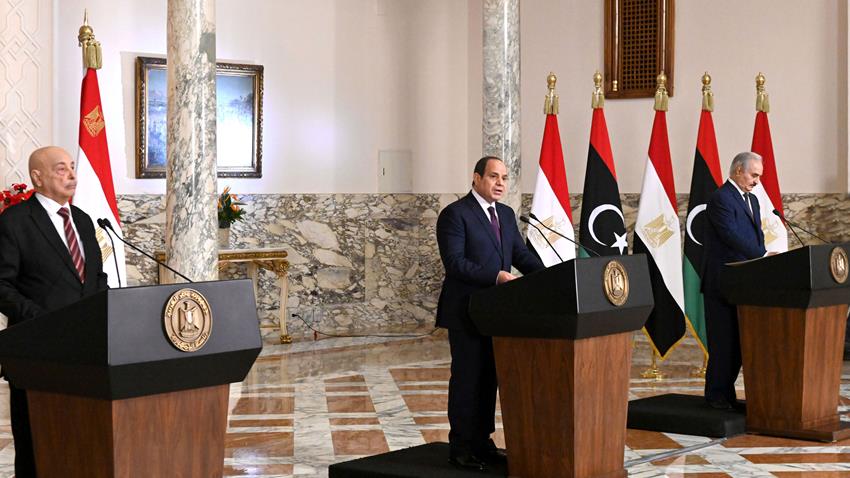
The most prominent items of the "Cairo Declaration" initiative on Libya.
Objectives:
The initiative aims at emphasizing the unity, integrity and independence of Libya, respecting all international efforts and initiatives as well as the relevant Security Council resolutions. Therefore, all parties shall be committed to ceasing fire within 600 days at least on 6/6/2020.
The initiative is based mainly on the "Berlin" summit outcomes, which resulted in a comprehensive political solution that includes obvious implementation steps at the political, security, and economic levels. It is also based on the respect for human rights and international humanitarian law, an investment in the "Berlin" conference outcomes in terms of the agreement of the leaders of the countries concerned with the Libyan crisis.
The works of the 5 + 5 Libyan Joint Military Commission in "Geneva", sponsored by the United Nations, are completed. As a result, the political, security, and economic levels will be a success. It is also important for the United Nations and the international community to oblige all foreign parties to eliminate foreign mercenaries nationwide, dismantle militias, and hand over their weapons. Thus, the armed forces (the Libyan National Army) in cooperation with the security apparatuses will be able to carry out their military and security responsibilities.
The Libyan state shall be able to restore its national institutions together with improving the political level under the auspices of the United Nations as an investment in the efforts of the international community to resolve the Libyan crisis.
The state shall have control over all security institutions and support of the military institution (the Libyan National Army) that assumes its responsibilities in combating terrorism as well as the assertion of its role in cooperation with the security and police services to protect the Libyan sovereignty and restore security in the maritime, air, and land fields.
The Presidential Council shall take its decisions by a majority vote, except for the sovereign decisions regarding the armed forces. In this case, decisions submitted by the Commander-in-Chief of the armed forces shall be made or proposals adjudicated unanimously in the presence of the Commander-in-Chief of the Armed Forces.
The main themes of the initiative:
The three Libyan regions - eastern, western and southern - to form an electoral entity whose members are chosen from the House of Representatives and the State Council representing each region together with tribal elders and notabilities. An acceptable representation of women and youth as well as intellectual political elites and unions shall be taken into account. Additionally, the three committees are meeting under the auspices of the United Nations and they are agreed upon; each region selects its representative, either by consensus or by election, within a period not exceeding 90 days.
Each province chooses its representative for the Presidential Council as well as a competent and patriotic deputy prime minister with the aim of forming a Presidency Council of a president and two deputies. Thus, the Presidential Council nominates the Prime Minister, who in turn, together with his two deputies, form a government and present it to the Presidential Council, in preparation for referring it to the House of Representatives.
The United Nations generally supervises electoral complexes to ensure the integrity of the process for selecting candidates for the Presidential Council.
Every province shall receive a proportionate number of ministerial portfolios depending on the percentage of population after a consensus is reached on the members of the new Presidential Council and the appointment of the prime minister provided that no province shall include more than one presidency for the three authorities (the Presidential Council – Parliament - Cabinet). Tripoli will receive nine ministerial portfolios, while Barqa (Cyrenaica) Province and Fezzan Province will hold seven and five portfolios respectively. The six sovereign ministries will be split among the three provinces equally, with each province holding two sovereign ministries. Two deputies are appointed for each minister from the other provinces.
The Libyan parliament should adopt the amendments of the constitutional declaration through a legal committee to be formed by the Council’s President, Counselor Aguila Saleh, after the committee (including representatives of the members of the House of Representatives and the State Council) would agree on the points to be amended in the constitutional declaration within 30 days from the beginning of the first session.
The initiative provides that the electoral college, selected by each province under UN supervision, shall form a committee comprising national figures and constitutional experts to draft a new constitution for the country and put it to a referendum. The committee shall execute its duties within 90 days of its formation.
The initiative set the transitional period at 18 months, to be expanded to no more than six additional months, during which all state institutions, especially principal economic ones, such as the Central Bank of Libya, the National Oil Corporation and the Libyan Investment Authority, will be reorganized. The boards of directors of the recent institutions shall be restructured to ensure the effectiveness of the government performance and the provision of the necessary resources to manage the transitional phase, as well as the organization of presidential and parliamentary elections.
The initiative calls for adopting all the necessary measures for unifying state economic and oil institutions in East and West Libya, implementing economic and structural reforms, denying terrorist militias access to Libyan funds and working on providing a fair distribution of resources in the Libyan society.


Saturday, 06 June 2020 / 04:50 PM
The most prominent items of the "Cairo Declaration" initiative on Libya.
Objectives:
The initiative aims at emphasizing the unity, integrity and independence of Libya, respecting all international efforts and initiatives as well as the relevant Security Council resolutions. Therefore, all parties shall be committed to ceasing fire within 600 days at least on 6/6/2020.
The initiative is based mainly on the "Berlin" summit outcomes, which resulted in a comprehensive political solution that includes obvious implementation steps at the political, security, and economic levels. It is also based on the respect for human rights and international humanitarian law, an investment in the "Berlin" conference outcomes in terms of the agreement of the leaders of the countries concerned with the Libyan crisis.
The works of the 5 + 5 Libyan Joint Military Commission in "Geneva", sponsored by the United Nations, are completed. As a result, the political, security, and economic levels will be a success. It is also important for the United Nations and the international community to oblige all foreign parties to eliminate foreign mercenaries nationwide, dismantle militias, and hand over their weapons. Thus, the armed forces (the Libyan National Army) in cooperation with the security apparatuses will be able to carry out their military and security responsibilities.
The Libyan state shall be able to restore its national institutions together with improving the political level under the auspices of the United Nations as an investment in the efforts of the international community to resolve the Libyan crisis.
The state shall have control over all security institutions and support of the military institution (the Libyan National Army) that assumes its responsibilities in combating terrorism as well as the assertion of its role in cooperation with the security and police services to protect the Libyan sovereignty and restore security in the maritime, air, and land fields.
The Presidential Council shall take its decisions by a majority vote, except for the sovereign decisions regarding the armed forces. In this case, decisions submitted by the Commander-in-Chief of the armed forces shall be made or proposals adjudicated unanimously in the presence of the Commander-in-Chief of the Armed Forces.
The main themes of the initiative:
The three Libyan regions - eastern, western and southern - to form an electoral entity whose members are chosen from the House of Representatives and the State Council representing each region together with tribal elders and notabilities. An acceptable representation of women and youth as well as intellectual political elites and unions shall be taken into account. Additionally, the three committees are meeting under the auspices of the United Nations and they are agreed upon; each region selects its representative, either by consensus or by election, within a period not exceeding 90 days.
Each province chooses its representative for the Presidential Council as well as a competent and patriotic deputy prime minister with the aim of forming a Presidency Council of a president and two deputies. Thus, the Presidential Council nominates the Prime Minister, who in turn, together with his two deputies, form a government and present it to the Presidential Council, in preparation for referring it to the House of Representatives.
The United Nations generally supervises electoral complexes to ensure the integrity of the process for selecting candidates for the Presidential Council.
Every province shall receive a proportionate number of ministerial portfolios depending on the percentage of population after a consensus is reached on the members of the new Presidential Council and the appointment of the prime minister provided that no province shall include more than one presidency for the three authorities (the Presidential Council – Parliament - Cabinet). Tripoli will receive nine ministerial portfolios, while Barqa (Cyrenaica) Province and Fezzan Province will hold seven and five portfolios respectively. The six sovereign ministries will be split among the three provinces equally, with each province holding two sovereign ministries. Two deputies are appointed for each minister from the other provinces.
The Libyan parliament should adopt the amendments of the constitutional declaration through a legal committee to be formed by the Council’s President, Counselor Aguila Saleh, after the committee (including representatives of the members of the House of Representatives and the State Council) would agree on the points to be amended in the constitutional declaration within 30 days from the beginning of the first session.
The initiative provides that the electoral college, selected by each province under UN supervision, shall form a committee comprising national figures and constitutional experts to draft a new constitution for the country and put it to a referendum. The committee shall execute its duties within 90 days of its formation.
The initiative set the transitional period at 18 months, to be expanded to no more than six additional months, during which all state institutions, especially principal economic ones, such as the Central Bank of Libya, the National Oil Corporation and the Libyan Investment Authority, will be reorganized. The boards of directors of the recent institutions shall be restructured to ensure the effectiveness of the government performance and the provision of the necessary resources to manage the transitional phase, as well as the organization of presidential and parliamentary elections.
The initiative calls for adopting all the necessary measures for unifying state economic and oil institutions in East and West Libya, implementing economic and structural reforms, denying terrorist militias access to Libyan funds and working on providing a fair distribution of resources in the Libyan society.

All rights reserved to the presidency Copyright © 2020
All rights reserved to the presidency Copyright © 2020