
All rights reserved to the presidency Copyright © 2020


President Abdel Fattah El-Sisi inaugurated the Museum of Islamic Art after its restoration and rehabilitation.
Upon his arrival, the President unveiled the memorial plaque marking the inauguration of the museum, where the ambassadors of the countries that contributed to the project participated in that ceremony.
El-Sisi listened to an explanation by Minister of Antiquities, Dr. Khaled El-Anani, in which he reviewed the history and importance of the museum as well as the project of its restoration and rehabilitation within the framework of the state's role in reforming what terrorism corrupted, preserving the cultural and human heritage of Egypt and contributing to restoring terrorism. The President and the guests had a tour in the Museum's halls and collections.
The idea of establishing a Museum of Islamic Art and Antiquities came during the reign of Khedive Ismail in 1869 and it was implemented during the reign of Khedive Tawfiq in 1880 when Franz Pasha collected antiquities that date back to the Islamic era in a hall in El-Hakim Mosque. In 1882, the number of antiquities collected was 111 masterpieces. A small building was then built in the courtyard of the El-Hakim Mosque and it was named “The Arab Museum” under the management of Franz Pasha who left the service in 1892. The current museum building was inaugurated in the reign of Khedive Abbas Helmy II on December 28, 1903, then its name was changed in 1951 to be "Museum of Islamic Art".
- The museum has two entrances, one in the north-east and the other in the south-east that is now in use. The facade of the museum overlooks Port Said Street and it is decorated with Islamic motifs inspired by Islamic architecture in Egypt in its various eras.
- The museum consists of two floors; the first has exhibition halls and the second has stores, basement used as a store and the department of restoration of monuments.
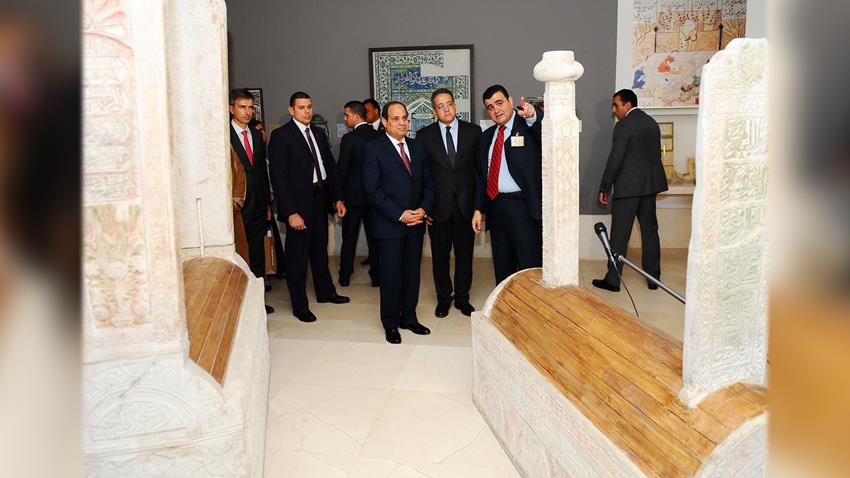
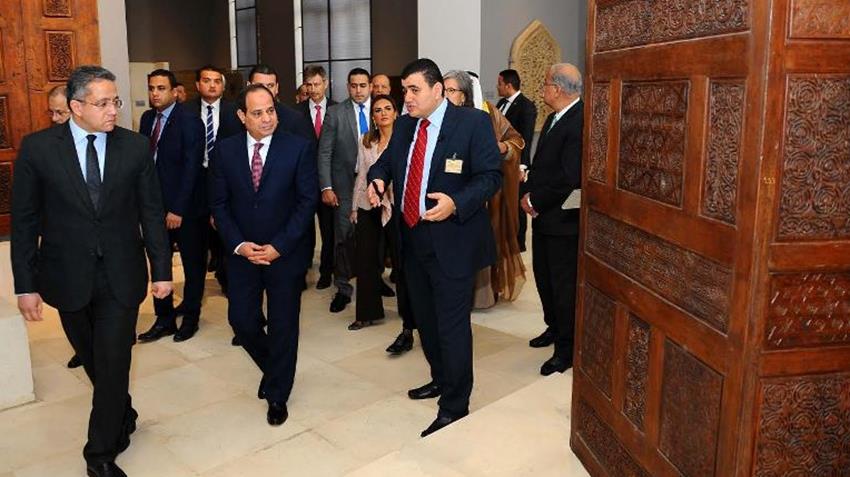
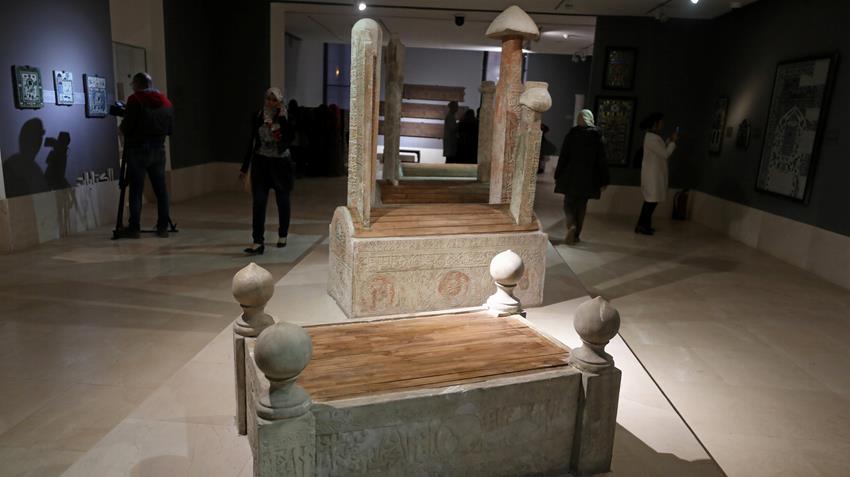
President Abdel Fattah El-Sisi inaugurated the Museum of Islamic Art after its restoration and rehabilitation.
Upon his arrival, the President unveiled the memorial plaque marking the inauguration of the museum, where the ambassadors of the countries that contributed to the project participated in that ceremony.
El-Sisi listened to an explanation by Minister of Antiquities, Dr. Khaled El-Anani, in which he reviewed the history and importance of the museum as well as the project of its restoration and rehabilitation within the framework of the state's role in reforming what terrorism corrupted, preserving the cultural and human heritage of Egypt and contributing to restoring terrorism. The President and the guests had a tour in the Museum's halls and collections.
The idea of establishing a Museum of Islamic Art and Antiquities came during the reign of Khedive Ismail in 1869 and it was implemented during the reign of Khedive Tawfiq in 1880 when Franz Pasha collected antiquities that date back to the Islamic era in a hall in El-Hakim Mosque. In 1882, the number of antiquities collected was 111 masterpieces. A small building was then built in the courtyard of the El-Hakim Mosque and it was named “The Arab Museum” under the management of Franz Pasha who left the service in 1892. The current museum building was inaugurated in the reign of Khedive Abbas Helmy II on December 28, 1903, then its name was changed in 1951 to be "Museum of Islamic Art".
- The museum has two entrances, one in the north-east and the other in the south-east that is now in use. The facade of the museum overlooks Port Said Street and it is decorated with Islamic motifs inspired by Islamic architecture in Egypt in its various eras.
- The museum consists of two floors; the first has exhibition halls and the second has stores, basement used as a store and the department of restoration of monuments.
- The museum sections are "ceramics, pottery, wood, metal, glass and textile".
- The museum has more than 103,000 antique pieces.
The Museum of Islamic Art in Cairo is considered the largest museum specialized in Islamic art in the world, as it contains more than one hundred thousand masterpieces covering all branches of Islamic art in various eras, and its art collections were distinguished by their richness in terms of quantity and quality, which made it a beacon for Islamic arts and civilization throughout its history , And became a resource for all researchers, historians and visitors of all categories, in order to become familiar with the history of Islamic civilization in various fields of science such as medicine, engineering, and astronomy, where museum collections include manuscripts and masterpieces in medicine, surgery, herbs, and astronomy tools from astrolabes, compasses, and Astronomical balls, and in the field of sub-arts that represent the necessities of life, such as metal, glass, and ceramic utensils, ornaments, weapons, woods, ivory, textiles, carpets, and others. The Museum of Islamic Art, since its inception before it, was for the great visitors of the kings and the greats of the world.
On January 24, 2014, a car bomb targeted the Cairo Security Directorate opposite the museum. The explosion led to the destruction of the facade of the museum corresponding to the Directorate, destroying many of the antiques. Ansar Bait El-Maqdis claimed responsibility for the terrorist bombing. The following day, UNESCO donated a large sum of money to restore the antiques and reopen the museum. An official at the Egyptian Ministry of Antiquities said that the renovation will be completed in less than four months.
All negatives have been taken into account in the style and method of the previous museum exhibits, as the museum used to follow a museum’s philosophy before the event of its destruction, mixing a museum’s philosophy of mixing two styles. .
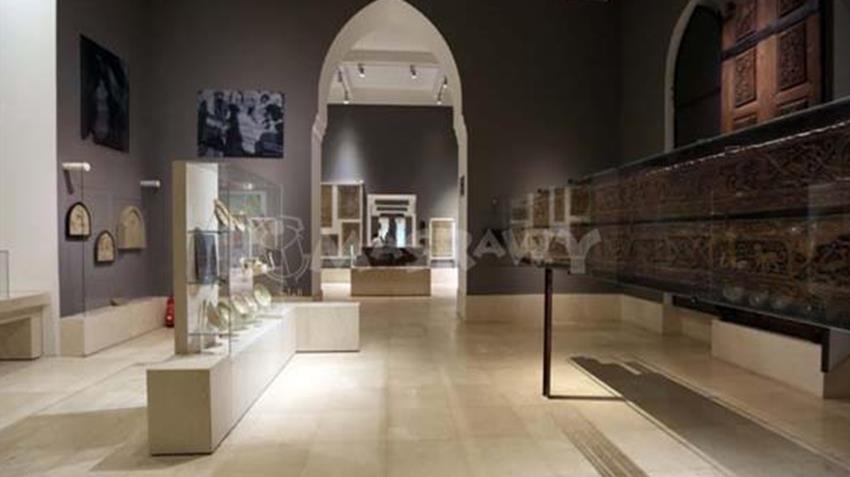
The design of the new screenplay scenario crystallizes in 25 halls, 14 of which are arranged according to historical sequence, and the rest of the halls are divided into separate topics, including medicine, science and astronomy, as well as "Islamic life" which is the daily life in the Muslim house.
3 new halls have been added to the museum ... and a major amendment was made to three other halls, the most important of which is the museum entrance, which now expresses the foundations of Islamic civilization in an attractive way.
The tour starts from the entrance, where a new scenario was drawn up for the entrance hall to reflect the virtues of civilization and Islamic arts. It was extracted from the Holy Qur’an, the Noble Prophet’s Sunnah, and Eastern and Western influences, to show the contributions it made to the world in all fields.
The Museum of Islamic Art is the largest Islamic art museum in the world, and includes more than 100,000 diverse artifacts from Islamic arts from India, China and Iran, passing through the arts of Arabia, the Levant, Egypt, North Africa and Andalusia.
The number of artifacts on display has been increased to 4,400 different artifacts, and the most important treasures of the museum have been removed from the stores, where 400 artifacts are displayed for the first time.


All rights reserved to the presidency Copyright © 2020
All rights reserved to the presidency Copyright © 2020