
All rights reserved to the presidency Copyright © 2020


Wednesday, 14 October 2026 / 07:05 PM
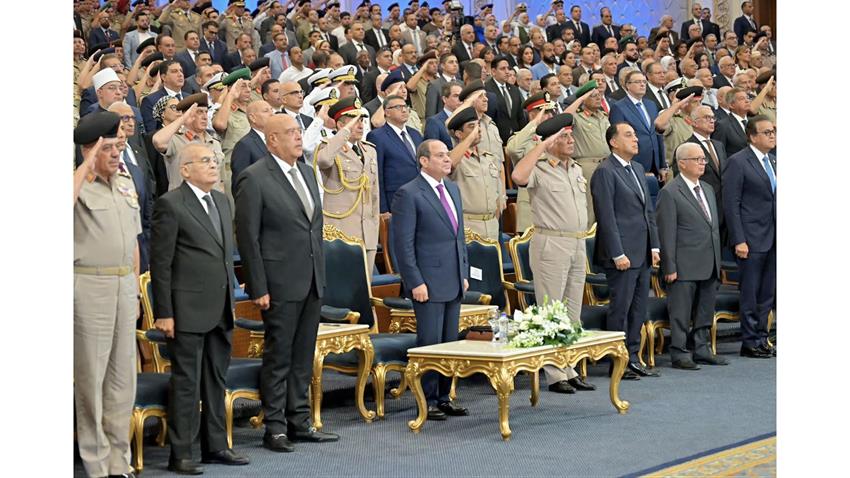
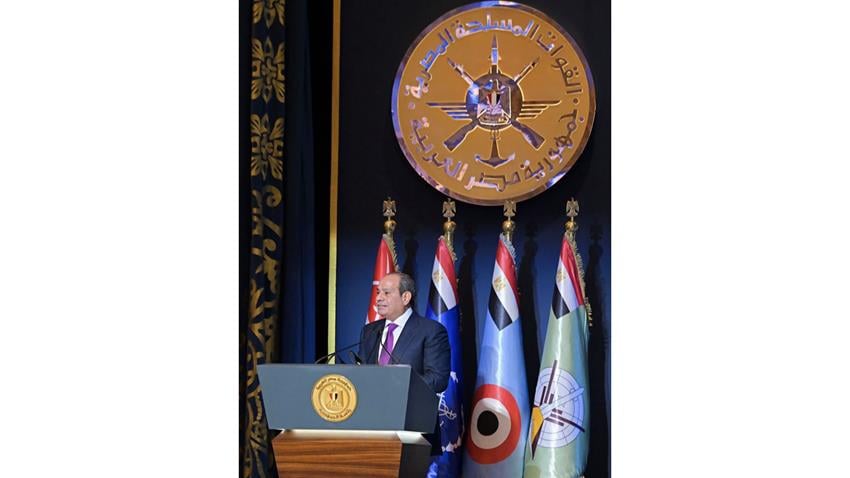
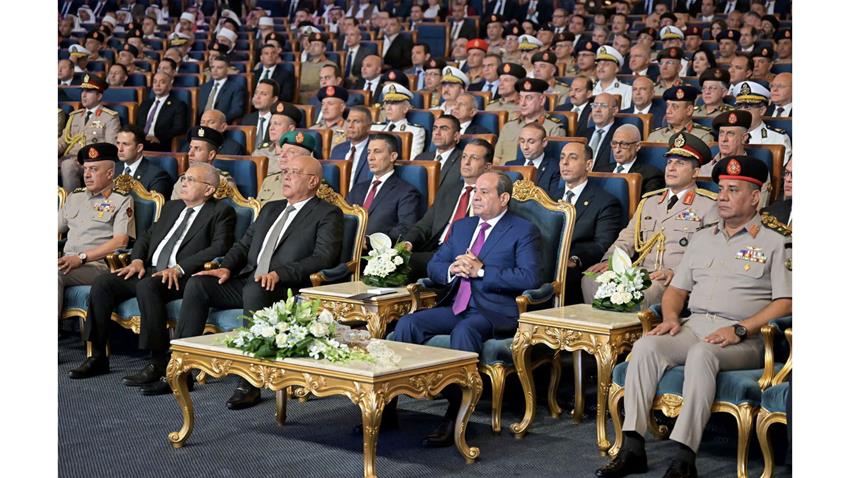
Today, President Abdel Fattah El-Sisi, President of the Republic and Supreme Commander of the Armed Forces, attended the 44th Cultural Symposium titled "Homeland of Heroes," marking the 53rd anniversary of the glorious October victories, held at the Al-Safwa International Convention Center at the Egyptian Military Academy in the New Capital.
The Spokesman for the Presidency, Ambassador Mohamed El-Shennawy, stated that upon his arrival, the President was received by Prime Minister Dr. Moustafa Madbouly, Commander-in-Chief of the Armed Forces, Minister of Defense and Military Production Lieutenant General Ashraf Salem Zaher,
and Chief of Staff of the Armed Forces Lieutenant General Ahmed Khalifa.
Speaker of the House of Representatives Counselor Hisham Badawi, Speaker of the Senate Counselor Essam El-Din Farid, Deputy Prime Minister for Economic Affairs Dr. Hussein Eissa, as well as a number of ministers and senior commanders of the Armed Forces also received the President.
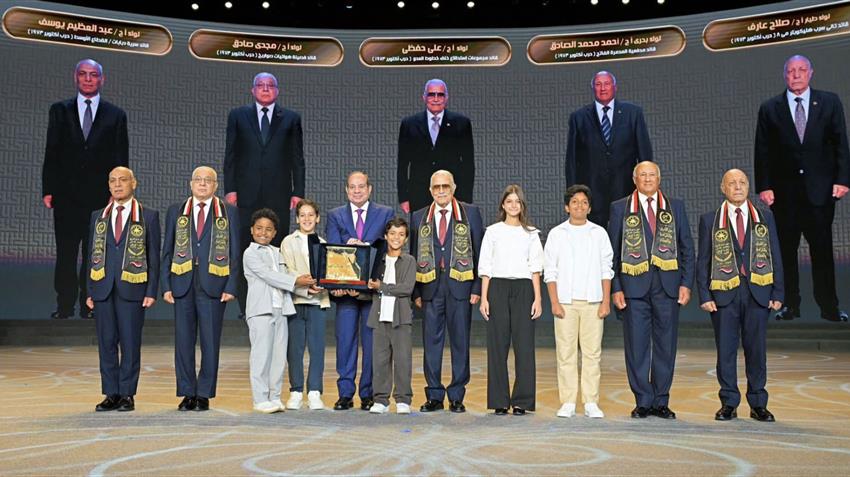
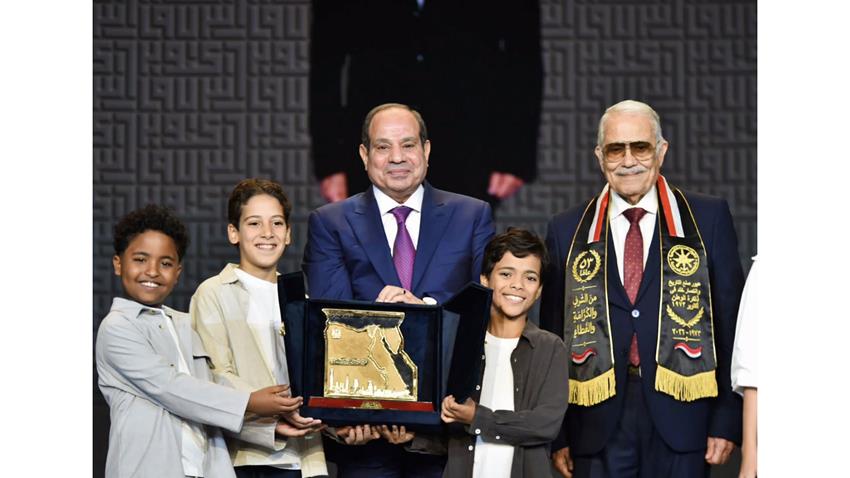
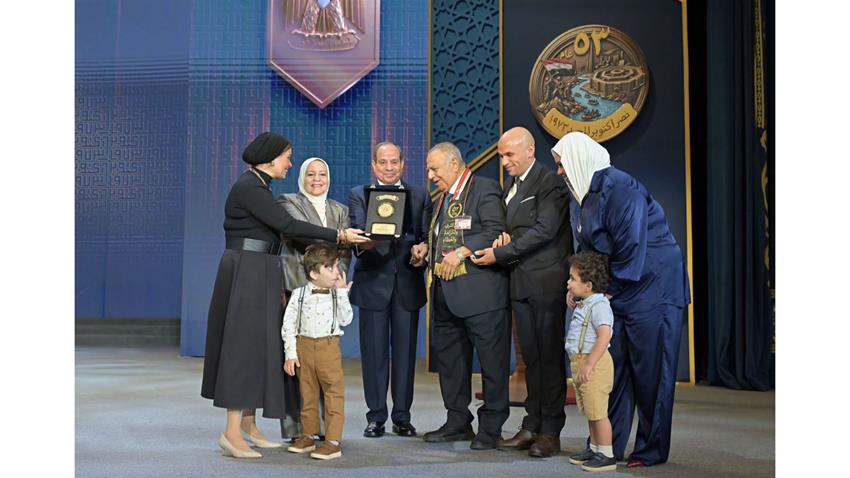
The ceremony started with a recitation of verses from the Holy Quran, followed by a presentation segment titled "The Time Machine: Story of My Hero Grandfather," which included a documentary film titled "A Journey Through Time." The ceremony also featured a segment titled "The Role of Egyptian Diplomacy During the October 1973 War," followed by the song "In Sound and Picture" performed with the participation of the Ministry of Youth and Sports Choir. A documentary film titled "Egypt Speaks for Itself," was screened followed by the segment "Egypt’s Soil is Worth More Than Gold," which concluded with a group of children presenting the President with the "Soil of the Nation" shield.
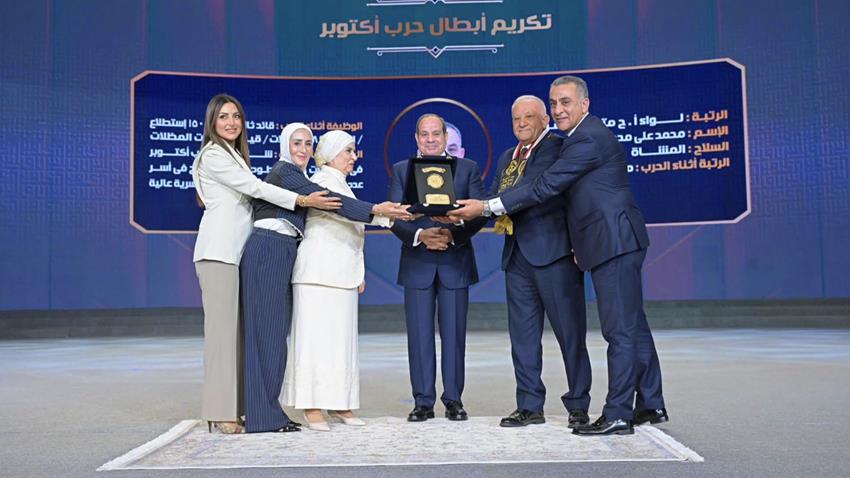
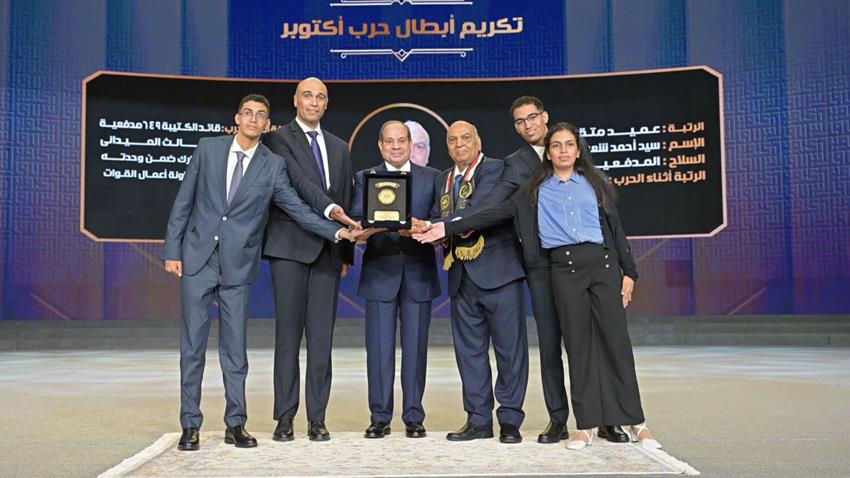
President El-Sisi then took to the stage to salute several heroes of the October War and take a commemorative photograph with them.
The ceremony also included a segment titled "The Heroes," followed by the song "The Egyptians" with the Youth and Sports Ministry Choir, and a speech by Eng. Ziad Abdel Tawab, Digital Transformation and Information Security Expert and Member of the Supreme Council for Culture, addressing the impact of social media in spreading misconceptions and misleading society. This was followed by the operetta "Egypt: History."
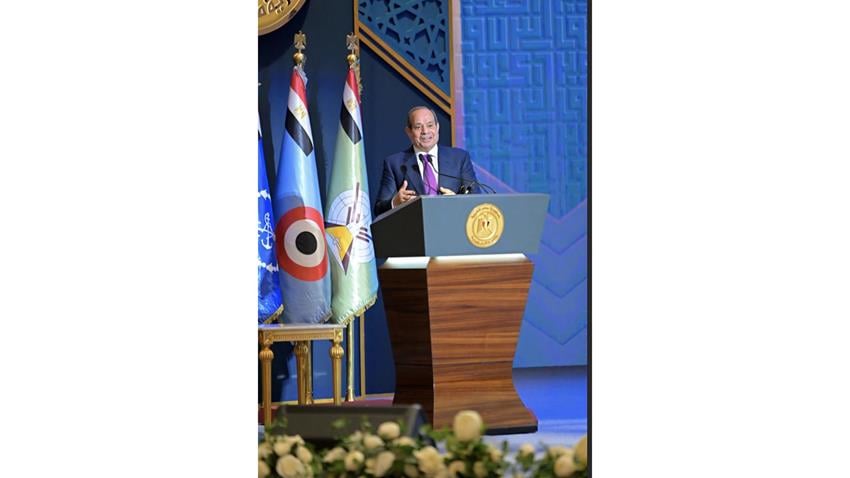
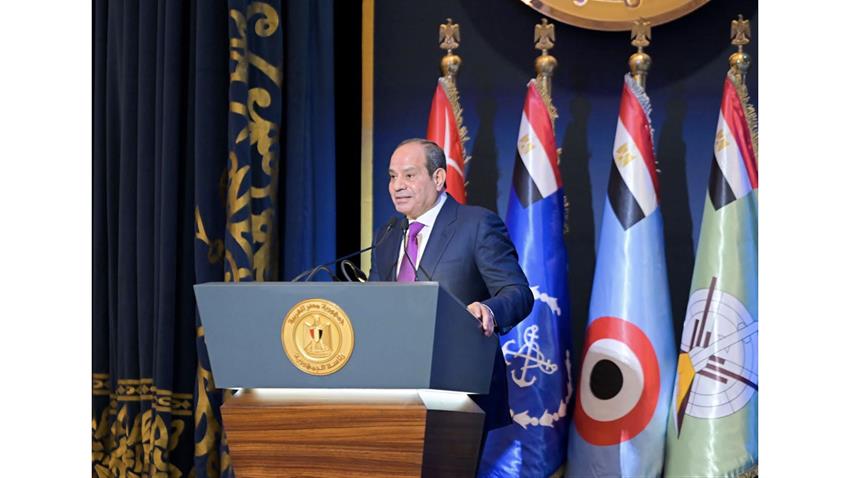
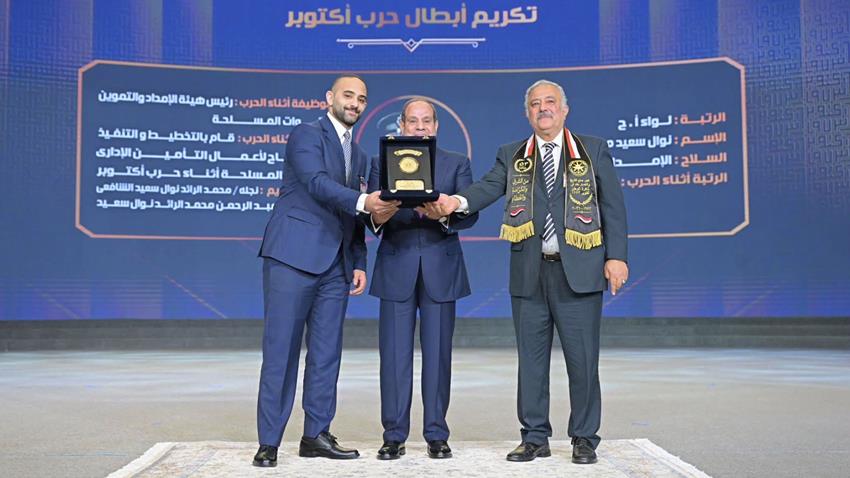
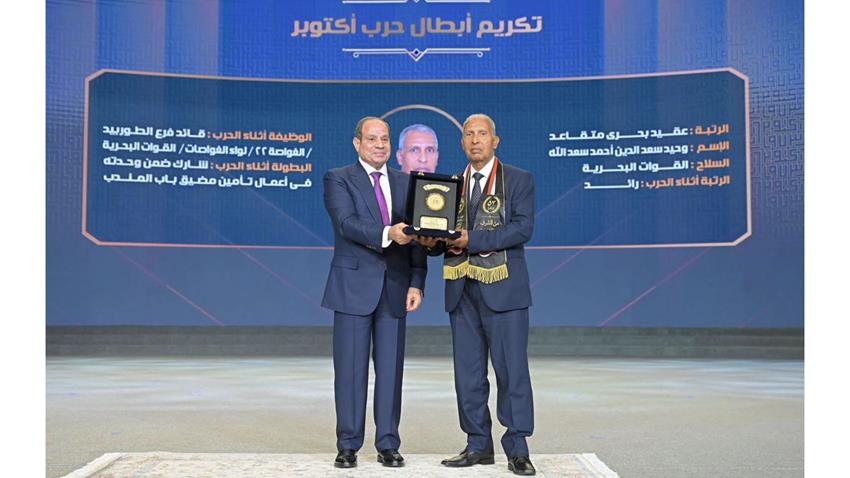
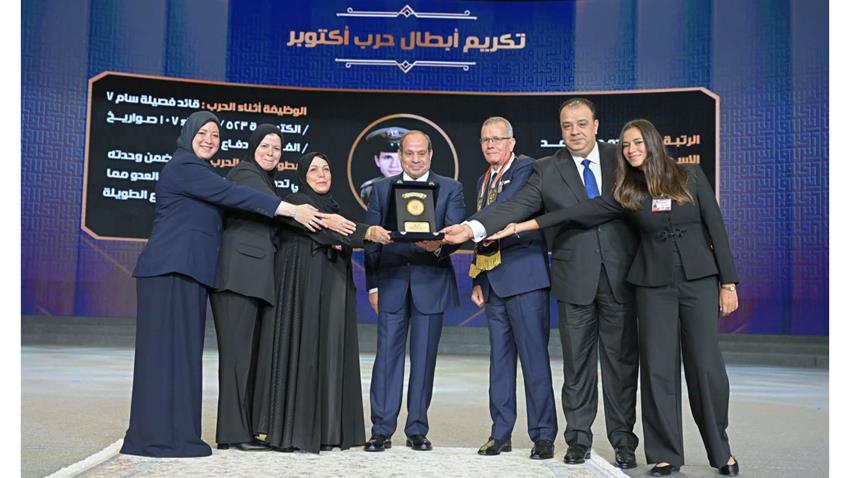
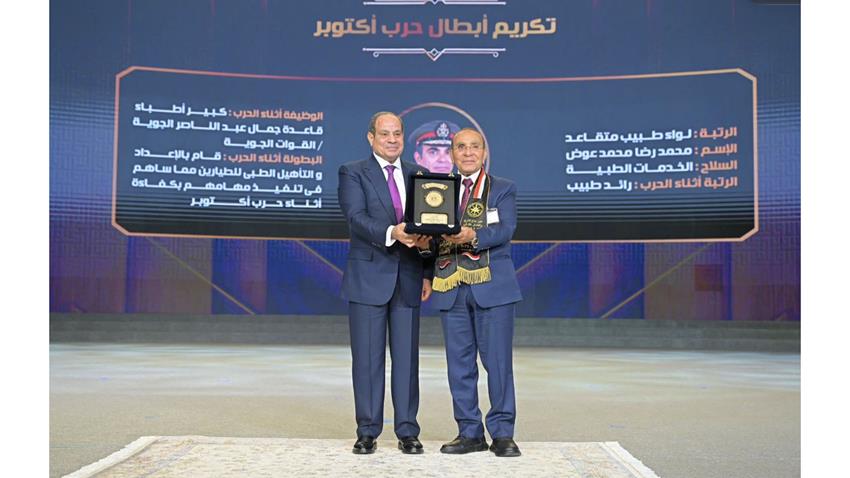
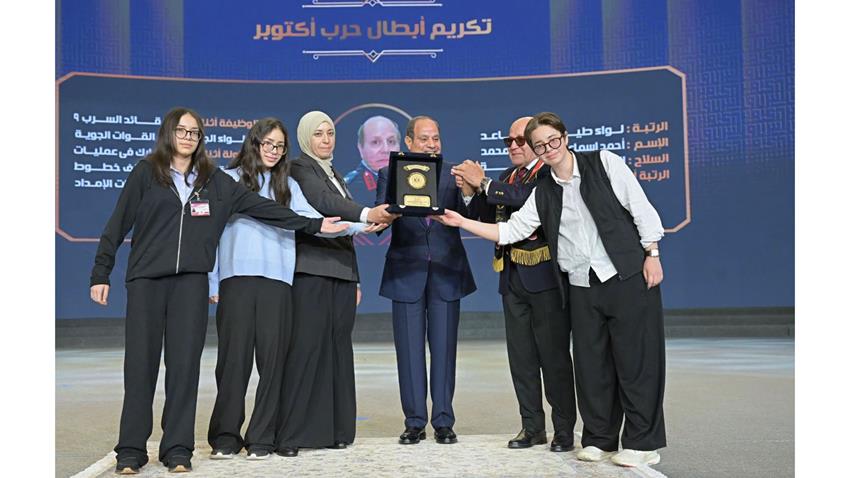
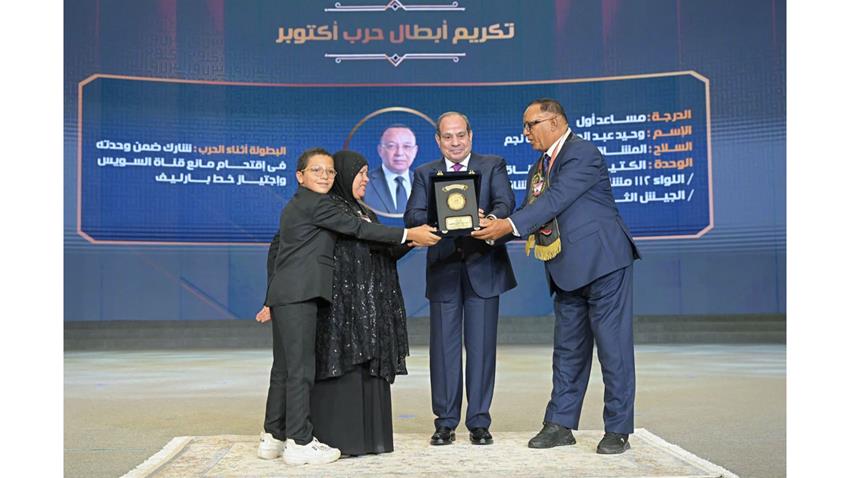
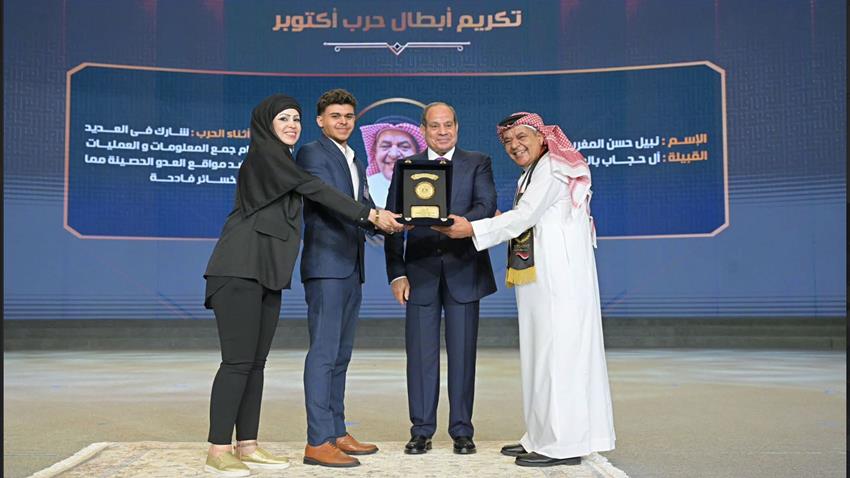
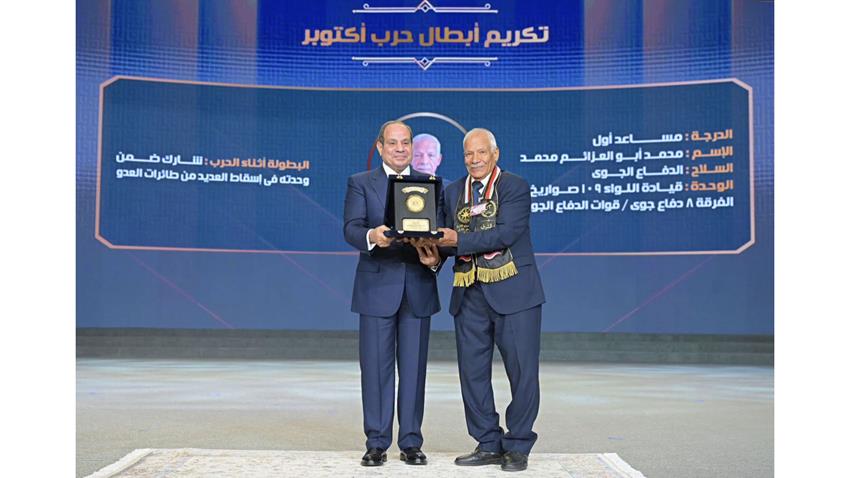
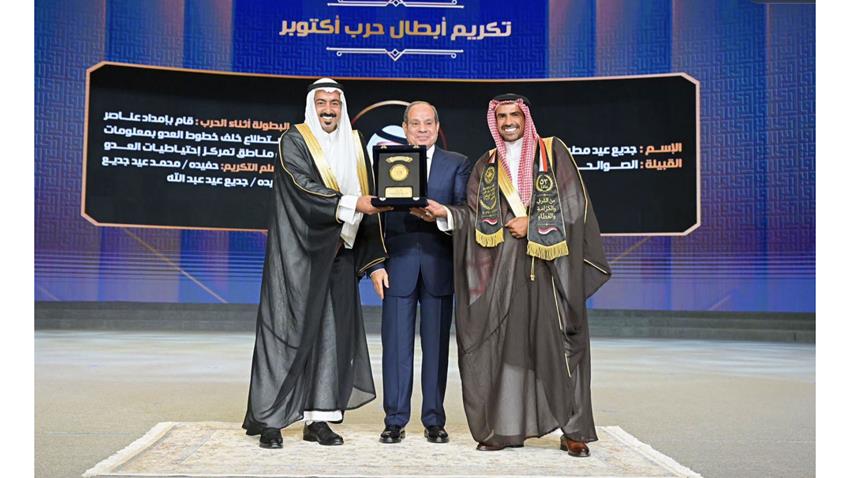
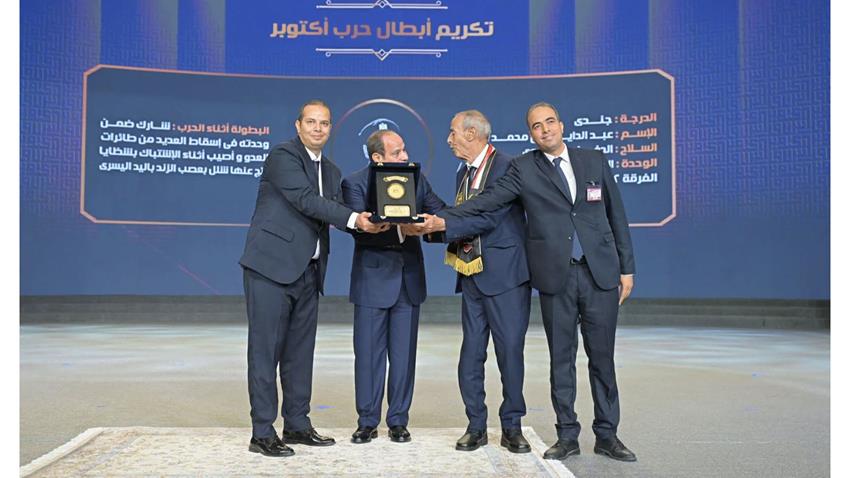
President El-Sisi also honored a number of heroes of the glorious October and delivered remarks on this occasion.
The President noted that he preferred to re-present the content of a speech he delivered years ago, emphasizing that its message remains relevant today given that no fundamental change has occurred in the nature of the challenges facing the state, which necessitates continued vigilance and caution.
The President added that Mr. Ahmed Aboul Gheit—drawing on his extensive political experience and as a witness to key milestones in the nation’s history—compared in his remarks the challenges that faced the Egyptian state in 1973 with those it faced in 2013. The President explained that the main challenge in 2013 was to restore the Egyptian state and safeguard its national identity following attempts to seize control of it and alter its trajectory, noting that in both cases, Egyptians and their Armed Forces stood as one to defend the nation.
The President highlighted a connection between the events of 1973 and 2013, explaining that the late President Anwar El- Sadat possessed vision and foresight and initiated an economic reform program in 1976. However, certain measures taken at the time, including price increases on specific goods, were met with opposition and demonstrations that led the state to backtrack from completing that path, despite the significant status President Sadat earned following the October Victory.
In this context, the President stressed the vital importance of preserving national awareness, warning against attempts aimed at distorting the national memory and erasing historical facts, and underscoring that nation-building is an ongoing effort. In 1977, state resources did not permit that, despite Egypt’s population at the time not exceeding 40 million.
The President noted that attempts to influence citizens' awareness and falsify facts continue to this day, citing efforts aimed at casting doubt on the glorious October Victory or diminishing its significance through media tools and modern technologies, mainly social media.
The President emphasized that national memory constitutes any nation's first line of defense, and that tampering with it ultimately weakens people's capacity to perceive facts and distinguish right from wrong, causing direct harm to the future and stability of homelands.
The President added that the Egyptian state has witnessed economic reform attempts since 1976, and today continues to implement an economic reform program aimed at boosting its capacities and achieving development. The President explained that a politician had advised the late President Anwar El- Sadat to release members of religious groups from prison to counter another political current active on the Egyptian scene at the time—a step that ultimately led to President Sadat’s assassination. The President reaffirmed that ongoing attempts seek to undermine national awareness, shatter collective memory, and weaken citizens' resolve, stressing that economic challenges can be overcome, but what matters most is preserving the state, its survival and continuity, particularly since challenges remain in the journey of nations across all stages of their development.
In this context, President El-Sisi pointed out that, in 2013, the Egyptian people viewed Field Marshal Abdel Fattah El-Sisi as a hero. The President added that, over the past fourteen years, Egypt has waged a fierce war against terrorism, during which the state incurred costs exceeding $120 billion, in addition to the sacrifices made and the martyrs offered by the sons of the nation. Nevertheless, thanks to Allah the Almighty, that battle ultimately resulted in the achievement of security and stability.
President El-Sisi emphasized that the most prominent threat that still persists lies in the attempt to target national awareness and tamper with the collective memory of the Egyptian people. The President noted that Allah the Almighty had saved Egypt and its people from the circumstances the country was facing before 2013. The President stressed the need for everyone to assume their responsibilities, each in their respective position, in order to raise public awareness and explain the dangers of attempts to undermine states from within, particularly in light of systematic campaigns targeting the Egyptian state and seeking to negatively affect its stability and cohesion.
The President also affirmed that confronting these challenges is not the responsibility of state institutions alone, but rather a joint national responsibility requiring concerted efforts by the state and society as a whole.
President El-Sisi highlighted that, during his tenure as Director of Military Intelligence, he was keen to communicate and meet with various political currents and presidential candidates, with the aim of understanding their visions and assessing their ability to address the challenges facing the Egyptian state and propose practical solutions. The President added that he used to pose numerous questions to some representatives of religious movements regarding how they intended to manage state affairs and address existing challenges, in order to assess their readiness to assume the responsibilities of governance.
President El-Sisi noted that it was difficult to imagine a person or organization governing the state while calling on citizens to stage continuous protests over a period of eighteen months. This had severely depleted the state's resources and capabilities, including the erosion of the Central Bank's foreign currency reserves and the decline of the tourism sector, in addition to the negative repercussions for the country's overall economic and investment climate.
In this regard, the President recalled that Field Marshal Mohamed Hussein Tantawi, may he rest in peace, used to ask him whether power could be handed over to the Muslim Brotherhood. The President’s response at that time, during a meeting of the Supreme Council of the Armed Forces, was that if the people elected them, power could be handed over to them.
President El-Sisi added that he had believed that preserving the state and ensuring the continuity of its institutions remained an absolute priority, considering that it was better for any group or current to bear the responsibility of governance in accordance with the will of the people than for the state to be exposed to the risk of loss or collapse.
The President emphasized that the most important criterion for anyone sincerely devoted to their country is the preservation and continuity of the state, regardless of who is responsible for running its affairs.
President El-Sisi mentioned that, during his tenure as Director of Military Intelligence, the US ambassador to Egypt at the time used to inquire of him regarding his expectations of who would assume power in Egypt. His assessment was that the Muslim Brotherhood would come to power. The President added that he simultaneously expected them not to remain in power for long, based on his conviction that the challenges facing the Egyptian state were greater than any political movement, president, or group, but not greater than the capabilities and determination of the Egyptian people. The President also affirmed that Field Marshal Tantawi, may he rest in peace, was a wise man.
In the same context, President El-Sisi noted that the greatest challenge facing the Egyptian state would take no more than ten years to address, at most, and that the Egyptian state faces one challenge after another. The President added that, before the 1973 war, the national duty had been to work, and the Armed Forces had worked day and night in preparation for the battle, stressing that the national duty now is work as well.
In this regard, President El-Sisi also recalled that, during a 2014 meeting with media figures Ibrahim Eissa and Lamis El Hadidy, he had emphasized that work and patience were the only options available to Egypt. The President asserted that everyone recognizes the value of hard work and that this responsibility is not limited to government officials.
Commenting on social media, President El-Sisi mentioned that Dr. Ziad Abdel Tawab had addressed the subject of psychological warfare in his remarks. He explained that psychological warfare had existed even in the 1960s and 1970s, albeit through different means, and that it would continue. He added that its objective was to undermine the will of the Egyptian people, warning Egyptians against disinformation campaigns.
President El-Sisi stated that the country has a constitution—a constitution that the people approved for the state—and declared that no one would tamper with it. The President reiterated that no one would be allowed to touch the Constitution and stressed that no one should manipulate the minds of the Egyptian people.
President El-Sisi further explained that the rumors and deliberate attempts to distort public awareness and provoke public opinion that had emerged over the preceding months formed part of efforts aimed at destabilizing the country and fomenting unrest within the Egyptian state. The President further affirmed that the responsibility of confronting these plots rests upon everyone, by raising the level of awareness and clarifying the facts to public opinion, warning that exposing the state to disturbances similar to those witnessed in 2011 would entail severe repercussions threatening its stability and ability to endure.
President El-Sisi pointed out that Allah the Almighty had protected Egypt during the critical junctures it went through in 2011 and 2013, granting its people a new opportunity to safeguard their state and restore it to its proper course. In this context, the President urged all Egyptians, youth and elders, men and women, to remain committed to their homeland, strengthen their awareness, and fortify their country against attempts to target it and conspire against it. The President also emphasized that preserving the state is everyone's foremost national responsibility. He added: “Fortify your country against this conspiracy, I am not saying, fortify the President.”
Commenting on recent statements by an Israeli official concerning Sinai, President El-Sisi reaffirmed that Egypt had fought a war to defend its land and had recovered all its territory. The President questioned whether certain circles in Israel harbored unjustified perceptions or concerns about alleged Egyptian ambitions toward Israel. The President stressed that Egypt's sole and ultimate goal is to preserve its security and stability and safeguard the capabilities of its people, affirming that the Egyptian state carries no hidden agendas, and that its primary priority consists of preserving its borders and national security within a framework of peace and stability.
President El-Sisi added that the peace treaty signed between Egypt and Israel constitutes the governing framework for relations between the two sides, emphasizing that Egypt has no ambitions toward any other country. The President also explained that Egypt's support for the two-state solution stems from a steadfast vision and firm conviction that this approach represents the realistic path toward achieving a just and lasting peace in the region and establishing a respected Palestinian state alongside a respected Israeli state. The President also stressed that this is not a new proposal, but rather Egypt's established vision for achieving stability for generations to come.
President El-Sisi further stated that Egypt seeks to de-escalate tensions in the region, find a solution to the crisis in the Gulf, and ensure security and stability for its brothers in the Gulf states. The President reiterated that the national security of the Gulf states is an integral part of Egypt's national security, just as Egyptian national security is an extension of Gulf national security. The President reaffirmed that, on this basis, Egypt supports its brothers in the Gulf states and stands ready to do whatever is necessary to de-escalate tensions, ensure the safety of maritime navigation, and restore stability to the region.
President El-Sisi concluded his speech by addressing a message to the Egyptian people, saying: “Take care of Egypt; Take care of your country.”


Wednesday, 14 October 2026 / 07:05 PM
Today, President Abdel Fattah El-Sisi, President of the Republic and Supreme Commander of the Armed Forces, attended the 44th Cultural Symposium titled "Homeland of Heroes," marking the 53rd anniversary of the glorious October victories, held at the Al-Safwa International Convention Center at the Egyptian Military Academy in the New Capital.
The Spokesman for the Presidency, Ambassador Mohamed El-Shennawy, stated that upon his arrival, the President was received by Prime Minister Dr. Moustafa Madbouly, Commander-in-Chief of the Armed Forces, Minister of Defense and Military Production Lieutenant General Ashraf Salem Zaher,
and Chief of Staff of the Armed Forces Lieutenant General Ahmed Khalifa.
Speaker of the House of Representatives Counselor Hisham Badawi, Speaker of the Senate Counselor Essam El-Din Farid, Deputy Prime Minister for Economic Affairs Dr. Hussein Eissa, as well as a number of ministers and senior commanders of the Armed Forces also received the President.
The ceremony started with a recitation of verses from the Holy Quran, followed by a presentation segment titled "The Time Machine: Story of My Hero Grandfather," which included a documentary film titled "A Journey Through Time." The ceremony also featured a segment titled "The Role of Egyptian Diplomacy During the October 1973 War," followed by the song "In Sound and Picture" performed with the participation of the Ministry of Youth and Sports Choir. A documentary film titled "Egypt Speaks for Itself," was screened followed by the segment "Egypt’s Soil is Worth More Than Gold," which concluded with a group of children presenting the President with the "Soil of the Nation" shield.
President El-Sisi then took to the stage to salute several heroes of the October War and take a commemorative photograph with them.
The ceremony also included a segment titled "The Heroes," followed by the song "The Egyptians" with the Youth and Sports Ministry Choir, and a speech by Eng. Ziad Abdel Tawab, Digital Transformation and Information Security Expert and Member of the Supreme Council for Culture, addressing the impact of social media in spreading misconceptions and misleading society. This was followed by the operetta "Egypt: History."
President El-Sisi also honored a number of heroes of the glorious October and delivered remarks on this occasion.
The President noted that he preferred to re-present the content of a speech he delivered years ago, emphasizing that its message remains relevant today given that no fundamental change has occurred in the nature of the challenges facing the state, which necessitates continued vigilance and caution.
The President added that Mr. Ahmed Aboul Gheit—drawing on his extensive political experience and as a witness to key milestones in the nation’s history—compared in his remarks the challenges that faced the Egyptian state in 1973 with those it faced in 2013. The President explained that the main challenge in 2013 was to restore the Egyptian state and safeguard its national identity following attempts to seize control of it and alter its trajectory, noting that in both cases, Egyptians and their Armed Forces stood as one to defend the nation.
The President highlighted a connection between the events of 1973 and 2013, explaining that the late President Anwar El- Sadat possessed vision and foresight and initiated an economic reform program in 1976. However, certain measures taken at the time, including price increases on specific goods, were met with opposition and demonstrations that led the state to backtrack from completing that path, despite the significant status President Sadat earned following the October Victory.
In this context, the President stressed the vital importance of preserving national awareness, warning against attempts aimed at distorting the national memory and erasing historical facts, and underscoring that nation-building is an ongoing effort. In 1977, state resources did not permit that, despite Egypt’s population at the time not exceeding 40 million.
The President noted that attempts to influence citizens' awareness and falsify facts continue to this day, citing efforts aimed at casting doubt on the glorious October Victory or diminishing its significance through media tools and modern technologies, mainly social media.
The President emphasized that national memory constitutes any nation's first line of defense, and that tampering with it ultimately weakens people's capacity to perceive facts and distinguish right from wrong, causing direct harm to the future and stability of homelands.
The President added that the Egyptian state has witnessed economic reform attempts since 1976, and today continues to implement an economic reform program aimed at boosting its capacities and achieving development. The President explained that a politician had advised the late President Anwar El- Sadat to release members of religious groups from prison to counter another political current active on the Egyptian scene at the time—a step that ultimately led to President Sadat’s assassination. The President reaffirmed that ongoing attempts seek to undermine national awareness, shatter collective memory, and weaken citizens' resolve, stressing that economic challenges can be overcome, but what matters most is preserving the state, its survival and continuity, particularly since challenges remain in the journey of nations across all stages of their development.
In this context, President El-Sisi pointed out that, in 2013, the Egyptian people viewed Field Marshal Abdel Fattah El-Sisi as a hero. The President added that, over the past fourteen years, Egypt has waged a fierce war against terrorism, during which the state incurred costs exceeding $120 billion, in addition to the sacrifices made and the martyrs offered by the sons of the nation. Nevertheless, thanks to Allah the Almighty, that battle ultimately resulted in the achievement of security and stability.
President El-Sisi emphasized that the most prominent threat that still persists lies in the attempt to target national awareness and tamper with the collective memory of the Egyptian people. The President noted that Allah the Almighty had saved Egypt and its people from the circumstances the country was facing before 2013. The President stressed the need for everyone to assume their responsibilities, each in their respective position, in order to raise public awareness and explain the dangers of attempts to undermine states from within, particularly in light of systematic campaigns targeting the Egyptian state and seeking to negatively affect its stability and cohesion.
The President also affirmed that confronting these challenges is not the responsibility of state institutions alone, but rather a joint national responsibility requiring concerted efforts by the state and society as a whole.
President El-Sisi highlighted that, during his tenure as Director of Military Intelligence, he was keen to communicate and meet with various political currents and presidential candidates, with the aim of understanding their visions and assessing their ability to address the challenges facing the Egyptian state and propose practical solutions. The President added that he used to pose numerous questions to some representatives of religious movements regarding how they intended to manage state affairs and address existing challenges, in order to assess their readiness to assume the responsibilities of governance.
President El-Sisi noted that it was difficult to imagine a person or organization governing the state while calling on citizens to stage continuous protests over a period of eighteen months. This had severely depleted the state's resources and capabilities, including the erosion of the Central Bank's foreign currency reserves and the decline of the tourism sector, in addition to the negative repercussions for the country's overall economic and investment climate.
In this regard, the President recalled that Field Marshal Mohamed Hussein Tantawi, may he rest in peace, used to ask him whether power could be handed over to the Muslim Brotherhood. The President’s response at that time, during a meeting of the Supreme Council of the Armed Forces, was that if the people elected them, power could be handed over to them.
President El-Sisi added that he had believed that preserving the state and ensuring the continuity of its institutions remained an absolute priority, considering that it was better for any group or current to bear the responsibility of governance in accordance with the will of the people than for the state to be exposed to the risk of loss or collapse.
The President emphasized that the most important criterion for anyone sincerely devoted to their country is the preservation and continuity of the state, regardless of who is responsible for running its affairs.
President El-Sisi mentioned that, during his tenure as Director of Military Intelligence, the US ambassador to Egypt at the time used to inquire of him regarding his expectations of who would assume power in Egypt. His assessment was that the Muslim Brotherhood would come to power. The President added that he simultaneously expected them not to remain in power for long, based on his conviction that the challenges facing the Egyptian state were greater than any political movement, president, or group, but not greater than the capabilities and determination of the Egyptian people. The President also affirmed that Field Marshal Tantawi, may he rest in peace, was a wise man.
In the same context, President El-Sisi noted that the greatest challenge facing the Egyptian state would take no more than ten years to address, at most, and that the Egyptian state faces one challenge after another. The President added that, before the 1973 war, the national duty had been to work, and the Armed Forces had worked day and night in preparation for the battle, stressing that the national duty now is work as well.
In this regard, President El-Sisi also recalled that, during a 2014 meeting with media figures Ibrahim Eissa and Lamis El Hadidy, he had emphasized that work and patience were the only options available to Egypt. The President asserted that everyone recognizes the value of hard work and that this responsibility is not limited to government officials.
Commenting on social media, President El-Sisi mentioned that Dr. Ziad Abdel Tawab had addressed the subject of psychological warfare in his remarks. He explained that psychological warfare had existed even in the 1960s and 1970s, albeit through different means, and that it would continue. He added that its objective was to undermine the will of the Egyptian people, warning Egyptians against disinformation campaigns.
President El-Sisi stated that the country has a constitution—a constitution that the people approved for the state—and declared that no one would tamper with it. The President reiterated that no one would be allowed to touch the Constitution and stressed that no one should manipulate the minds of the Egyptian people.
President El-Sisi further explained that the rumors and deliberate attempts to distort public awareness and provoke public opinion that had emerged over the preceding months formed part of efforts aimed at destabilizing the country and fomenting unrest within the Egyptian state. The President further affirmed that the responsibility of confronting these plots rests upon everyone, by raising the level of awareness and clarifying the facts to public opinion, warning that exposing the state to disturbances similar to those witnessed in 2011 would entail severe repercussions threatening its stability and ability to endure.
President El-Sisi pointed out that Allah the Almighty had protected Egypt during the critical junctures it went through in 2011 and 2013, granting its people a new opportunity to safeguard their state and restore it to its proper course. In this context, the President urged all Egyptians, youth and elders, men and women, to remain committed to their homeland, strengthen their awareness, and fortify their country against attempts to target it and conspire against it. The President also emphasized that preserving the state is everyone's foremost national responsibility. He added: “Fortify your country against this conspiracy, I am not saying, fortify the President.”
Commenting on recent statements by an Israeli official concerning Sinai, President El-Sisi reaffirmed that Egypt had fought a war to defend its land and had recovered all its territory. The President questioned whether certain circles in Israel harbored unjustified perceptions or concerns about alleged Egyptian ambitions toward Israel. The President stressed that Egypt's sole and ultimate goal is to preserve its security and stability and safeguard the capabilities of its people, affirming that the Egyptian state carries no hidden agendas, and that its primary priority consists of preserving its borders and national security within a framework of peace and stability.
President El-Sisi added that the peace treaty signed between Egypt and Israel constitutes the governing framework for relations between the two sides, emphasizing that Egypt has no ambitions toward any other country. The President also explained that Egypt's support for the two-state solution stems from a steadfast vision and firm conviction that this approach represents the realistic path toward achieving a just and lasting peace in the region and establishing a respected Palestinian state alongside a respected Israeli state. The President also stressed that this is not a new proposal, but rather Egypt's established vision for achieving stability for generations to come.
President El-Sisi further stated that Egypt seeks to de-escalate tensions in the region, find a solution to the crisis in the Gulf, and ensure security and stability for its brothers in the Gulf states. The President reiterated that the national security of the Gulf states is an integral part of Egypt's national security, just as Egyptian national security is an extension of Gulf national security. The President reaffirmed that, on this basis, Egypt supports its brothers in the Gulf states and stands ready to do whatever is necessary to de-escalate tensions, ensure the safety of maritime navigation, and restore stability to the region.
President El-Sisi concluded his speech by addressing a message to the Egyptian people, saying: “Take care of Egypt; Take care of your country.”

All rights reserved to the presidency Copyright © 2020
All rights reserved to the presidency Copyright © 2020