
All rights reserved to the presidency Copyright © 2020


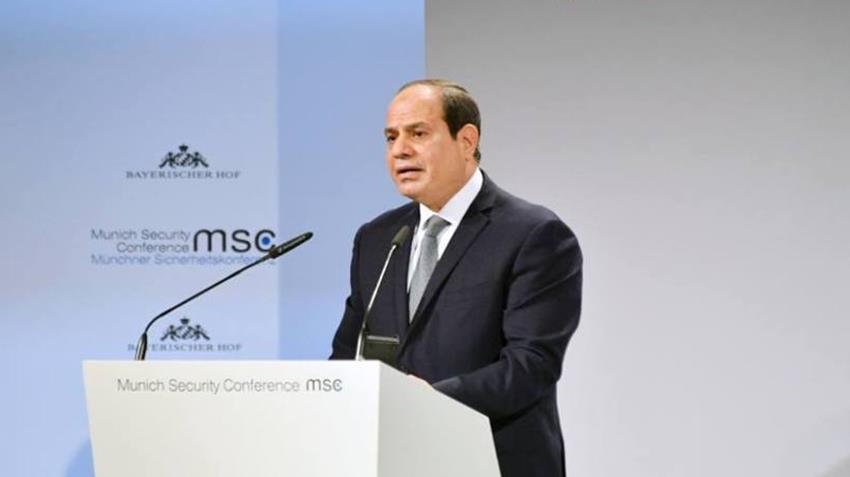
"Ladies and Gentlemen,
Allow me, at the outset, to thank ambassador Wolfgang Ischinger, chairman of the Munich Security conference, for inviting me to participate in this important forum, not only as a president of a state that dynamically interacts with its African and Arab regional environment, and effectively plays such a pivotal role in the pursuit of realizing security, stability and development in both the Middle East and the African continent, but also in view of the fact that Egypt, few days ago, was handed over the rotating presidency of the African Union for 2019, henceforth, it seeks as usual to highlight the concerns of sisterly African peoples yearning to achieve stability and progress, on one hand, and provide impetus to development on the other hand.
Distinguished Attendees,
The conference is taking place, this year, amid increasing and complex challenges and risks, namely the continues existence of international tension and conflict hotbeds, prevalence of the terrorism and extremism risks, and the escalating rates of the organized crime. All these challenges not only pose intense pressures as regards to the concept of the national state, but also cause collapse of its institutions in a way that renders the whole situation more complicated and endangers the peoples’ resources, security and stability. These challenges have been compounded by the state of polarization and intensification of political confrontations engulfing the international order, not to mention the impact of natural hazards, namely climate change, desertification, water shortage, among others. This requires strengthening international efforts, in view of the fact that the present-day challenges are far beyond the capacities of any single state to confront or contain, because these challenges no longer recognize geographical boundaries, and their impact now includes everyone.
Those challenges are manifested clearly in both the Middle East and the African continent. We are witnessing, nowadays, armed conflicts, civil wars, ethnic and sectarian clashes, and terrorist attacks, not to mention, problems of poverty, unemployment, low productivity and the declining standard of services provided and the related economic crises, financial market instability, capital inflows conditionality and exacerbating debt phenomenon. Henceforth, handling such problems requires genuine international cooperation based on reviewing and evaluating patterns of traditional cooperation so as to help to put an end to conflicts and enhance a number of fields of priority, namely entrenching the concepts of good governance, protecting human rights in their comprehensive concept, empowering women who make up half of society, upgrading education and health, developing infrastructure and agriculture, boosting rural development, creating job opportunities, increasing investments, promoting trade and strengthening regional integration and incorporation.
Ladies and Gentlemen,
Under such challenges, the priorities of the African Union’s agenda in 2019 revolve around boosting regional economic incorporation across the continent. This target can be attained by increasing investments in the field of infrastructure, facilitating the intra-trade movement via speeding up the implementation of the African Continental Free Trade Agreement (AFCFTA) as well as continuing to devise sustainable development programs and plans within the framework of Africa’s Agenda 2063 and put such plans into practice based on the phased and effective implementation side by side with national capacity-building in this vein.
In this context, it would be important to note that while being on the threshold of the year of “Silencing the Guns” in the Continent in 2020, one of the priorities of the states of the African Union is post-conflict reconstruction and development, thus realizing stability across the Continent through building and empowering the state of nation’s institutions to be able to effectively undertake their duties. In this vein, Egypt is working with the African Union Commission to launch the African Union Center for Post-Conflict Reconstruction and Development that will be hosted in Cairo. We hope that this center would be an effective regional tool to help the countries that have recently ended their armed conflicts to evaluate their needs and crystallize their national vision as regard to the process of reconstruction. Out of this concept, Egypt welcomes cooperation with all international partners, so as to lay the foundations of security system and achieve sustainable development in the African Continent, through strengthening cooperation, based on mobilizing resources and benefiting from extended expertise, on both the African and international levels. Investment in the African continent represents an investment for the future of all of us, as its population that exceeds one billion and its resources, potentials and wealth that, if properly utilized, can make Africa a locomotive of international economic growth over the coming decades.
Ladies and Gentlemen,
There is no doubt that terrorism has become an international phenomenon with increasing risks that lead to the destabilization of societies. This requires everyone to make unremitting and genuine efforts to uproot this abhorrent phenomenon, which constitutes the first threat to the pursuit of development, including tightening the noose around terrorist groups and organizations, or the countries that whether turn a blind eye to it, or even flagrantly support it, as a means to achieve political goals and regional ambitions.
It is worth emphasizing, in this context, that the failure to settle the Palestinian question, in a just and final way, is the main source of instability in the Middle East. This question is the oldest political conflict, a heavy legacy on our consciences, which we have been carrying since early the 20th century. There must be real collaborative efforts of the international community to put an end to this long-awaited conflict in accordance with the relevant and agreed upon international references, and in enforcement of the principle of the two-state solution as well as the right of the Palestinians to establish their independent state on the borders of 4 June 1967 with East Jerusalem as its capital, and alleviate their daily suffering, as this will form the nucleus of the actual start to reach successful solutions to the other conflicts.
One of the most pressing issues on the African arena is the security situation in Libya, which requires all of us to provide the necessary support for the political process and the efforts of the UN envoy, and to back and empower the state institutions, including the military. In this respect, Egypt has been keen to provide support to its brothers in Libya to help them regain their strength, unify the military and build a sustainable political process, which will reflect positively on the Libyan people as well as the regional situation in the North African and African Sahel areas.
In this context, also, I would like to talk about the issue of migration and refugees, which necessitates a comprehensive and innovative solution that takes into account the roots of the crises causing it, and seeks to alleviate the human suffering associated with that issue; especially that the greatest burden of the consequences of displacement and asylum lies on the shoulders of the neighboring countries, which receive the bulk of migrants and displaced people in Africa. In recognition of the importance of dealing effectively with this phenomenon, the African countries have engaged in the Valletta and Khartoum Processes. Some of them have contributed in laying down the International Covenant on Migration, as a framework for cooperation and joint action to find constructive solutions to this challenge.
The national efforts and initiatives in many African countries have also contributed in enhancing dealing with this phenomenon, including that exerted by Egypt, which succeeded in stopping any attempts of illegal migration across its shores since September 2016. Egypt, also, held bilateral dialogues with a number of European countries, seeking a bilateral cooperation to deal with this phenomenon, not only in terms of its repercussions, but also to discuss ways of overcoming it and its causes. Besides, Egypt hosts millions of refugees, who are living in full merger within the Egyptian society without any tangible external support, with complete care not to trade on this issue, which is related to humanitarian aspects in the first place.
Ladies and Gentlemen,
Egypt's belief in the importance of international dialogue in relation to issues of peace and security has motivated us to launch the first Aswan Forum on Security and Sustainable Development late 2019, to be an international platform to discuss ways to strengthen the interdependence between peace and development and to crystallize conceptual perceptions and practical ideas for transitional development programs aiming to promote the culture of peace and push the post-conflict reconstruction efforts.
Finally, we can confirm that security and policy axis, we aim to achieve in its comprehensive sense, politically, economically and culturally, will remain the common ground on which we all must focus and cooperate, in the years to come.
Thank you
May Allah's peace and mercy be upon you"


"Ladies and Gentlemen,
Allow me, at the outset, to thank ambassador Wolfgang Ischinger, chairman of the Munich Security conference, for inviting me to participate in this important forum, not only as a president of a state that dynamically interacts with its African and Arab regional environment, and effectively plays such a pivotal role in the pursuit of realizing security, stability and development in both the Middle East and the African continent, but also in view of the fact that Egypt, few days ago, was handed over the rotating presidency of the African Union for 2019, henceforth, it seeks as usual to highlight the concerns of sisterly African peoples yearning to achieve stability and progress, on one hand, and provide impetus to development on the other hand.
Distinguished Attendees,
The conference is taking place, this year, amid increasing and complex challenges and risks, namely the continues existence of international tension and conflict hotbeds, prevalence of the terrorism and extremism risks, and the escalating rates of the organized crime. All these challenges not only pose intense pressures as regards to the concept of the national state, but also cause collapse of its institutions in a way that renders the whole situation more complicated and endangers the peoples’ resources, security and stability. These challenges have been compounded by the state of polarization and intensification of political confrontations engulfing the international order, not to mention the impact of natural hazards, namely climate change, desertification, water shortage, among others. This requires strengthening international efforts, in view of the fact that the present-day challenges are far beyond the capacities of any single state to confront or contain, because these challenges no longer recognize geographical boundaries, and their impact now includes everyone.
Those challenges are manifested clearly in both the Middle East and the African continent. We are witnessing, nowadays, armed conflicts, civil wars, ethnic and sectarian clashes, and terrorist attacks, not to mention, problems of poverty, unemployment, low productivity and the declining standard of services provided and the related economic crises, financial market instability, capital inflows conditionality and exacerbating debt phenomenon. Henceforth, handling such problems requires genuine international cooperation based on reviewing and evaluating patterns of traditional cooperation so as to help to put an end to conflicts and enhance a number of fields of priority, namely entrenching the concepts of good governance, protecting human rights in their comprehensive concept, empowering women who make up half of society, upgrading education and health, developing infrastructure and agriculture, boosting rural development, creating job opportunities, increasing investments, promoting trade and strengthening regional integration and incorporation.
Ladies and Gentlemen,
Under such challenges, the priorities of the African Union’s agenda in 2019 revolve around boosting regional economic incorporation across the continent. This target can be attained by increasing investments in the field of infrastructure, facilitating the intra-trade movement via speeding up the implementation of the African Continental Free Trade Agreement (AFCFTA) as well as continuing to devise sustainable development programs and plans within the framework of Africa’s Agenda 2063 and put such plans into practice based on the phased and effective implementation side by side with national capacity-building in this vein.
In this context, it would be important to note that while being on the threshold of the year of “Silencing the Guns” in the Continent in 2020, one of the priorities of the states of the African Union is post-conflict reconstruction and development, thus realizing stability across the Continent through building and empowering the state of nation’s institutions to be able to effectively undertake their duties. In this vein, Egypt is working with the African Union Commission to launch the African Union Center for Post-Conflict Reconstruction and Development that will be hosted in Cairo. We hope that this center would be an effective regional tool to help the countries that have recently ended their armed conflicts to evaluate their needs and crystallize their national vision as regard to the process of reconstruction. Out of this concept, Egypt welcomes cooperation with all international partners, so as to lay the foundations of security system and achieve sustainable development in the African Continent, through strengthening cooperation, based on mobilizing resources and benefiting from extended expertise, on both the African and international levels. Investment in the African continent represents an investment for the future of all of us, as its population that exceeds one billion and its resources, potentials and wealth that, if properly utilized, can make Africa a locomotive of international economic growth over the coming decades.
Ladies and Gentlemen,
There is no doubt that terrorism has become an international phenomenon with increasing risks that lead to the destabilization of societies. This requires everyone to make unremitting and genuine efforts to uproot this abhorrent phenomenon, which constitutes the first threat to the pursuit of development, including tightening the noose around terrorist groups and organizations, or the countries that whether turn a blind eye to it, or even flagrantly support it, as a means to achieve political goals and regional ambitions.
It is worth emphasizing, in this context, that the failure to settle the Palestinian question, in a just and final way, is the main source of instability in the Middle East. This question is the oldest political conflict, a heavy legacy on our consciences, which we have been carrying since early the 20th century. There must be real collaborative efforts of the international community to put an end to this long-awaited conflict in accordance with the relevant and agreed upon international references, and in enforcement of the principle of the two-state solution as well as the right of the Palestinians to establish their independent state on the borders of 4 June 1967 with East Jerusalem as its capital, and alleviate their daily suffering, as this will form the nucleus of the actual start to reach successful solutions to the other conflicts.
One of the most pressing issues on the African arena is the security situation in Libya, which requires all of us to provide the necessary support for the political process and the efforts of the UN envoy, and to back and empower the state institutions, including the military. In this respect, Egypt has been keen to provide support to its brothers in Libya to help them regain their strength, unify the military and build a sustainable political process, which will reflect positively on the Libyan people as well as the regional situation in the North African and African Sahel areas.
In this context, also, I would like to talk about the issue of migration and refugees, which necessitates a comprehensive and innovative solution that takes into account the roots of the crises causing it, and seeks to alleviate the human suffering associated with that issue; especially that the greatest burden of the consequences of displacement and asylum lies on the shoulders of the neighboring countries, which receive the bulk of migrants and displaced people in Africa. In recognition of the importance of dealing effectively with this phenomenon, the African countries have engaged in the Valletta and Khartoum Processes. Some of them have contributed in laying down the International Covenant on Migration, as a framework for cooperation and joint action to find constructive solutions to this challenge.
The national efforts and initiatives in many African countries have also contributed in enhancing dealing with this phenomenon, including that exerted by Egypt, which succeeded in stopping any attempts of illegal migration across its shores since September 2016. Egypt, also, held bilateral dialogues with a number of European countries, seeking a bilateral cooperation to deal with this phenomenon, not only in terms of its repercussions, but also to discuss ways of overcoming it and its causes. Besides, Egypt hosts millions of refugees, who are living in full merger within the Egyptian society without any tangible external support, with complete care not to trade on this issue, which is related to humanitarian aspects in the first place.
Ladies and Gentlemen,
Egypt's belief in the importance of international dialogue in relation to issues of peace and security has motivated us to launch the first Aswan Forum on Security and Sustainable Development late 2019, to be an international platform to discuss ways to strengthen the interdependence between peace and development and to crystallize conceptual perceptions and practical ideas for transitional development programs aiming to promote the culture of peace and push the post-conflict reconstruction efforts.
Finally, we can confirm that security and policy axis, we aim to achieve in its comprehensive sense, politically, economically and culturally, will remain the common ground on which we all must focus and cooperate, in the years to come.
Thank you
May Allah's peace and mercy be upon you"

All rights reserved to the presidency Copyright © 2020
All rights reserved to the presidency Copyright © 2020