
All rights reserved to the presidency Copyright © 2020



"Brother, King Salman Bin Abdul Aziz Al Saud,
The Custodian of the Two Holy Shrines and King of Saudi Arabia
Your Majesties, Excellencies and Highnesses, Kings and Heads of Arab States
Your Excellency, Secretary General of the League of Arab States Ahmed Abul-Gheit
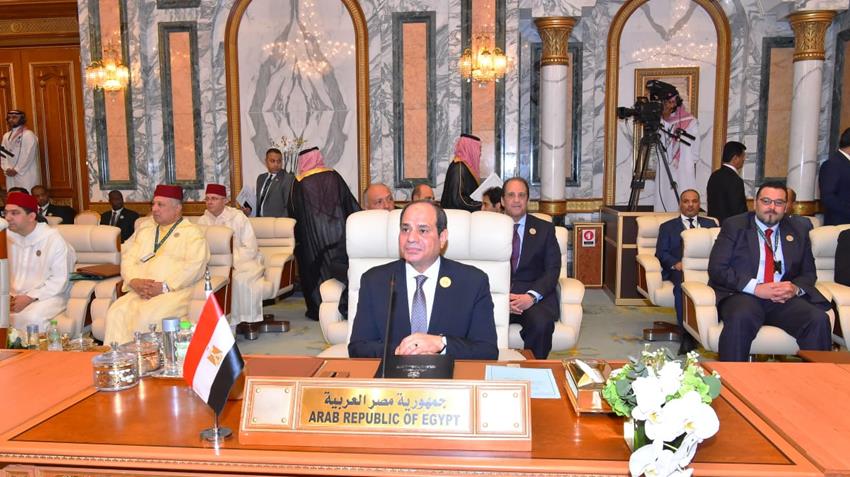
In the beginning, I would like to extend my sincere thanks to my brother, the Custodian of the Two Holy Shrines, King of Saudi Arabia Salman Bin Abdul Aziz, for holding this summit in Mecca, and for his hospitality and good organization, praying that God Almighty to render our efforts a success for the welfare of our Arab nation.
Your Majesties, Excellencies and Highnesses,
Undoubtedly, our summit is convened today amidst serious and unprecedented threats facing the Arab national security, especially in the Gulf region of great strategic importance. I think that I don’t need to affirm that the security of the Arab Gulf region is a main pillar of Arab national security from an Egyptian perspective, and it is closely linked with the Egyptian national security.
Hence, any threat facing Gulf security, and accordingly Arab national security, requires from all of us a decisive stand to confront it, with the utmost wisdom and firmness.
Firmness is a must to deliver a message to everyone in the world far and near, that the Arabs are not ready to compromise their national security and will not accept any prejudice to their rights. Showing wisdom is also a must to contain any tension and prevent matters from exploding; for Arabs have and will always be strong advocates of world peace and stability.
Allow me to seize this opportunity of our meeting today, in this blessed place, to review with you, elements of the Egyptian vision on dealing firmly and decisively with the threats that we are meet here today to discuss, and the threats that face the Arab national security in general. Let me outline this vision in four key elements:
First: the recent attacks on oil facilities in the Kingdom of Saudi Arabia by Al-Houthi militias, the repeated rocket-firing targeting Saudi cities and the acts of aggression targeting navigation in the United Arab Emirates territorial waters, are plain and clear acts of terror that should be vehemently condemned by the international community. These acts of terror require the world community to condemn and take an action to punish their perpetrators and make sure that they are never repeated so as to avoid putting Arab national security and international peace and security at any risk.
Since we call on the international community to take full responsibility for these terrorist threats, we also have a responsibility to reactivate their counter-terrorism mechanisms and consolidate their own terror-combat capabilities.
These recent terrorist threats to our Arab national security may be an important occasion to renew the discussion on activation of the joint Arab action mechanisms that have been proposed and not yet taken shape. This is the way to restore the initiative to the Arabs, and enable them to deter and confront any attempt to violate Arab national security quickly and decisively.
Second: Coinciding with the full support to our brothers in Saudi Arabia and United Arab Emirates against any threats to their territories, facilities or territorial water, yet there is a need for a strategic approach to the area's crises and roots of instability that challenge the Arab national security, bringing together political and security procedures. The Arab states, while they will not tolerate any threat to their security, they will always remain at the forefront of the advocates for peace and dialogue. There is no need to ensure that the Arabs are most keen on having healthy neighboring relations, based on the principles of respect for the Arab states sovereignty and non-interference in their affairs, and refraining from any attempt to provoke sectarian and ethnic prejudices. Those who adhere to these principles shall find an Arab hand extended to them offering peace and cooperation.
Third: The desired strategic approach for the Arab national security requires dealing simultaneously with all sources of threat to the security of the region, on top of which is the Palestinian cause; the main Arab cause and the main source of instability in the region. Stability in the region cannot be achieved without the comprehensive and peaceful solution that meets the legitimate Palestinian aspirations for independence, puts an end to occupation and establishes an independent and fully sovereign Palestinian state on the borders of June 1967, with East Jerusalem as its capital. It is also meaningless to talk about a comprehensive strategic approach to Arab national security without having a clear vision to address the ongoing crises in Syria, Libya and Yemen, to enable these Arab countries to restore their unity and sovereignty and fulfill their people’s hopes to live in freedom and a decent life away from interventions and greed of regional or external countries, warlords, or terrorist and sectarian militias.
Fourth: The necessary condition to build this comprehensive strategic approach for the Arab national security must be based on facing all regional and foreign interferences in the Arab countries on the same degree of decisiveness. The Arab states won’t tolerate any regional party threatening dear Arab countries’ water and facilities or attempting to spread its influence through sectarian militias that work for its narrow interests.
With the same logic, the Arab states don’t accept presence of military occupation forces of a regional party on the territories of two Arab states, or regional party supports a militia with arms and equipment.
The Arab national security and its healthy neighborly relations require, first and foremost, a sincere and determined stand with every regional party that tries to intervene in the Arab affairs. It also requires a frank stand with any Arab party that deviates from the requirements of the Arab national security and participates in the interventions in the internal affairs of other Arab countries.
Your Majesties, Excellencies and Highnesses,
Our meeting here today is meant, in the first place, at sending a clear message that we stand side by side with our brothers in Saudi Arabia and the United Arab Emirates and emphasize our determination to adopt a comprehensive strategic approach to the Arab national security that restore the historic initiative of the Arabs, and be proportional to the size of the risks and challenges facing our Arab security during this phase, and with the nature of the hopes that the Arab peoples attach to our meeting.
May God help us all to serve the causes of our Arab nation and maintain its national security,
Peace be upon you"


"Brother, King Salman Bin Abdul Aziz Al Saud,
The Custodian of the Two Holy Shrines and King of Saudi Arabia
Your Majesties, Excellencies and Highnesses, Kings and Heads of Arab States
Your Excellency, Secretary General of the League of Arab States Ahmed Abul-Gheit
In the beginning, I would like to extend my sincere thanks to my brother, the Custodian of the Two Holy Shrines, King of Saudi Arabia Salman Bin Abdul Aziz, for holding this summit in Mecca, and for his hospitality and good organization, praying that God Almighty to render our efforts a success for the welfare of our Arab nation.
Your Majesties, Excellencies and Highnesses,
Undoubtedly, our summit is convened today amidst serious and unprecedented threats facing the Arab national security, especially in the Gulf region of great strategic importance. I think that I don’t need to affirm that the security of the Arab Gulf region is a main pillar of Arab national security from an Egyptian perspective, and it is closely linked with the Egyptian national security.
Hence, any threat facing Gulf security, and accordingly Arab national security, requires from all of us a decisive stand to confront it, with the utmost wisdom and firmness.
Firmness is a must to deliver a message to everyone in the world far and near, that the Arabs are not ready to compromise their national security and will not accept any prejudice to their rights. Showing wisdom is also a must to contain any tension and prevent matters from exploding; for Arabs have and will always be strong advocates of world peace and stability.
Allow me to seize this opportunity of our meeting today, in this blessed place, to review with you, elements of the Egyptian vision on dealing firmly and decisively with the threats that we are meet here today to discuss, and the threats that face the Arab national security in general. Let me outline this vision in four key elements:
First: the recent attacks on oil facilities in the Kingdom of Saudi Arabia by Al-Houthi militias, the repeated rocket-firing targeting Saudi cities and the acts of aggression targeting navigation in the United Arab Emirates territorial waters, are plain and clear acts of terror that should be vehemently condemned by the international community. These acts of terror require the world community to condemn and take an action to punish their perpetrators and make sure that they are never repeated so as to avoid putting Arab national security and international peace and security at any risk.
Since we call on the international community to take full responsibility for these terrorist threats, we also have a responsibility to reactivate their counter-terrorism mechanisms and consolidate their own terror-combat capabilities.
These recent terrorist threats to our Arab national security may be an important occasion to renew the discussion on activation of the joint Arab action mechanisms that have been proposed and not yet taken shape. This is the way to restore the initiative to the Arabs, and enable them to deter and confront any attempt to violate Arab national security quickly and decisively.
Second: Coinciding with the full support to our brothers in Saudi Arabia and United Arab Emirates against any threats to their territories, facilities or territorial water, yet there is a need for a strategic approach to the area's crises and roots of instability that challenge the Arab national security, bringing together political and security procedures. The Arab states, while they will not tolerate any threat to their security, they will always remain at the forefront of the advocates for peace and dialogue. There is no need to ensure that the Arabs are most keen on having healthy neighboring relations, based on the principles of respect for the Arab states sovereignty and non-interference in their affairs, and refraining from any attempt to provoke sectarian and ethnic prejudices. Those who adhere to these principles shall find an Arab hand extended to them offering peace and cooperation.
Third: The desired strategic approach for the Arab national security requires dealing simultaneously with all sources of threat to the security of the region, on top of which is the Palestinian cause; the main Arab cause and the main source of instability in the region. Stability in the region cannot be achieved without the comprehensive and peaceful solution that meets the legitimate Palestinian aspirations for independence, puts an end to occupation and establishes an independent and fully sovereign Palestinian state on the borders of June 1967, with East Jerusalem as its capital. It is also meaningless to talk about a comprehensive strategic approach to Arab national security without having a clear vision to address the ongoing crises in Syria, Libya and Yemen, to enable these Arab countries to restore their unity and sovereignty and fulfill their people’s hopes to live in freedom and a decent life away from interventions and greed of regional or external countries, warlords, or terrorist and sectarian militias.
Fourth: The necessary condition to build this comprehensive strategic approach for the Arab national security must be based on facing all regional and foreign interferences in the Arab countries on the same degree of decisiveness. The Arab states won’t tolerate any regional party threatening dear Arab countries’ water and facilities or attempting to spread its influence through sectarian militias that work for its narrow interests.
With the same logic, the Arab states don’t accept presence of military occupation forces of a regional party on the territories of two Arab states, or regional party supports a militia with arms and equipment.
The Arab national security and its healthy neighborly relations require, first and foremost, a sincere and determined stand with every regional party that tries to intervene in the Arab affairs. It also requires a frank stand with any Arab party that deviates from the requirements of the Arab national security and participates in the interventions in the internal affairs of other Arab countries.
Your Majesties, Excellencies and Highnesses,
Our meeting here today is meant, in the first place, at sending a clear message that we stand side by side with our brothers in Saudi Arabia and the United Arab Emirates and emphasize our determination to adopt a comprehensive strategic approach to the Arab national security that restore the historic initiative of the Arabs, and be proportional to the size of the risks and challenges facing our Arab security during this phase, and with the nature of the hopes that the Arab peoples attach to our meeting.
May God help us all to serve the causes of our Arab nation and maintain its national security,
Peace be upon you"

All rights reserved to the presidency Copyright © 2020
All rights reserved to the presidency Copyright © 2020